Four ways to talk to a GPU
CUDA, ROCm, and OpenCL all compile the same generated CUDA-C string; Vulkan compiles its own GLSL. Switch one string in .on("...") and rerun — and see why the vendor-neutral graphics API beats AMD's own compute stack on AMD's own chip.
Module 4.1 named vulkan, rocm, and cuda as "compiles to a shader or a
device kernel" and stopped there. They're not three flavors of the same
thing. Two of them are the same generated string, compiled by two
different vendors' compilers; one of them mechanically rewrites that
string into a different C dialect; and one of them isn't C at all.
The whole story
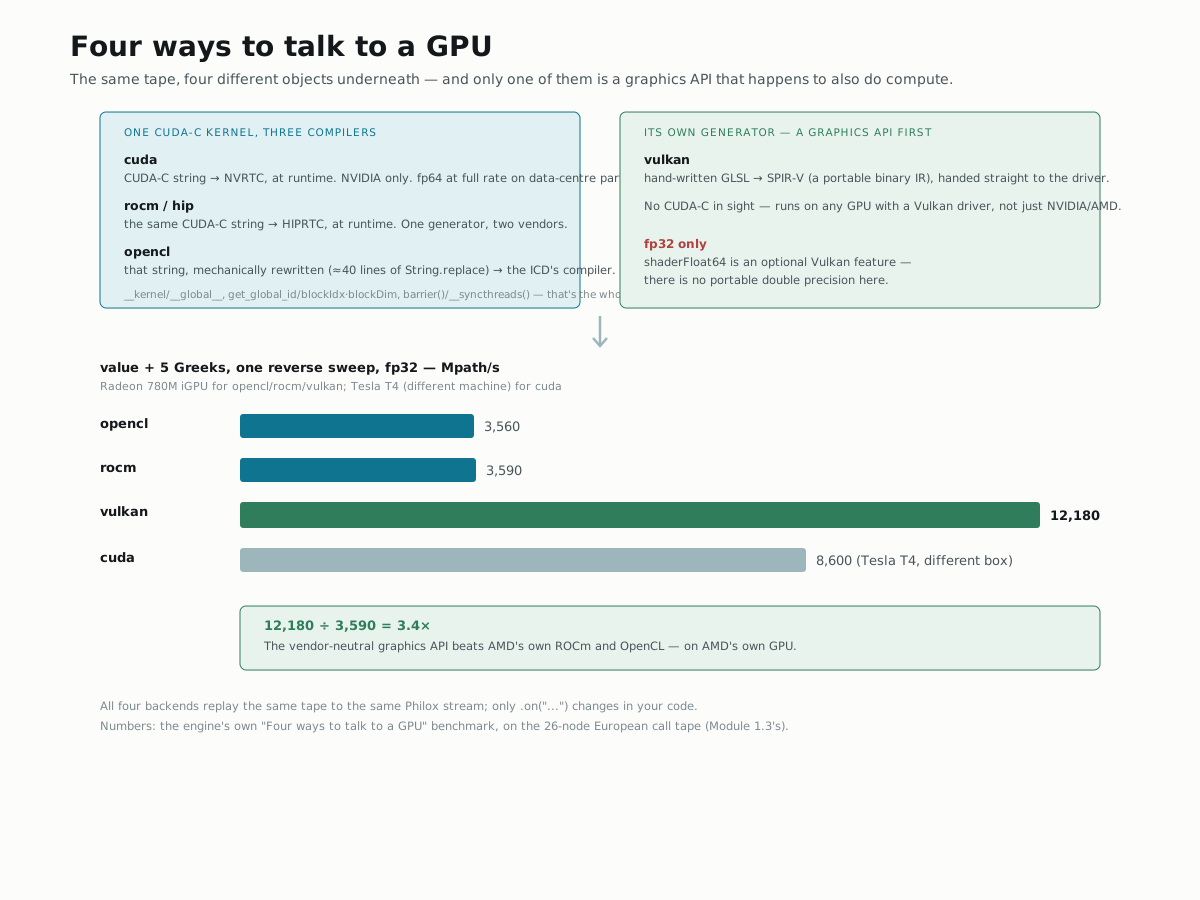
The opencl backend is about forty lines of String.replace. NVRTC (CUDA)
and HIPRTC (ROCm) both accept the exact same CUDA-C source, so cuda and
rocm already share one code generator, verbatim. OpenCL C differs from
CUDA C in a small, closed set of ways — __kernel for __global__,
get_global_id(0) for blockIdx.x * blockDim.x + threadIdx.x, __local
for __shared__, barrier() for __syncthreads() — so the opencl
backend takes the same generated CUDA-C string and rewrites exactly
those tokens before handing it to the driver's own compiler. Three
backends, one generator, nothing to keep in sync by hand.
Same string, three compilers, and one that isn't
Nothing about your code changes except the argument to .on(...):
try (MonteCarlo<EquityMarket> mc = MonteCarlo.of(Products.europeanCall())
        .market(EquityMarket.atmOneYear())
        .steps(1)
        .greeks()
        .on(engine)          // "cuda" | "rocm" | "opencl" | "vulkan"
        .fp32()
        .build()) {
    var v = mc.run(100_000_000L, 42L);
}
Underneath, cuda, rocm, and opencl all start from the identical
generated CUDA-C kernel — one forward sweep, one reverse sweep, entirely
in registers, one scenario per thread. cuda hands that string to
NVRTC; rocm hands the same string to HIPRTC; opencl hands
the token-rewritten version to whichever driver's ICD compiler is
installed. vulkan never sees that string at all — it compiles
hand-written GLSL to SPIR-V, a portable binary instruction format, and
that's what the driver actually runs. It's the only one of the four that
isn't, underneath, a dialect of C.
The number that makes this page worth reading
On one AMD Radeon 780M integrated GPU, replaying the same 26-node tape 1.3
built (Products.europeanCall(), one step), value plus all five Greeks,
fp32:
| backend | Mpath/s | vs. price-only |
|---|---|---|
opencl | 3,560 | ~2.5× |
rocm / HIP | 3,590 | ~2.5× |
vulkan | 12,180 | 1.3× |
Vulkan — a graphics API, from a standards committee, running on a driver AMD did not write — beats both of AMD's own compute stacks by 3.4×, on AMD's own silicon. Not a rounding difference: three and a half times.
Why would the committee standard win? Nothing to do with API design, and
everything to do with where the engineering went. Vulkan's compute path is
thin — a SPIR-V module and a dispatch, almost nothing between your kernel
and the shader cores — where ROCm and OpenCL both route through the
heavier HSA queue machinery in amdkfd. And the shader compiler behind
Vulkan on this GPU, RADV's ACO backend, is written and tuned largely by
Valve, because every game on the Steam Deck depends on it. On a
gfx1103 APU, that compute path runs a large fraction of the games on
Steam; ROCm runs approximately none of them. Testing volume is a
performance feature.
cuda, and the double-precision catch
cuda isn't in the table above — the numbers there are all one machine's
integrated GPU, and NVIDIA's card in this comparison is a Tesla T4 on a
different box entirely, so it doesn't belong in the same ranking. On its
own hardware it does 8,600 Mpath/s on this same tape, ahead of the 780M's
rocm/opencl rows and behind Vulkan's — a genuinely different machine,
not an apples-to-apples fourth row.
Precision is where vulkan's story has a real catch. cuda and rocm
both do full fp64 on the hardware they're built for; opencl gets it as
an optional extension most drivers implement. vulkan cannot — SPIR-V's
shaderFloat64 is an optional feature, and there's no double-precision
type in core GLSL at all. If a regulator needs the bank's number in double
precision, vulkan is off the table before performance enters the
conversation.
Try it yourself
Take any GPU example and change one string. If you have an NVIDIA card,
switch .on("cuda") to .on("vulkan") and rerun — same seed, same path
count, and the price and every Greek should reconcile to the same digits;
only throughput moves. On an AMD box like this one, the equivalent flip is
.on("rocm") to .on("vulkan") — one word, same tape, same result,
different silicon path underneath.
▶️ Run it
mvn -o -q install
mvn -o -q -pl nablatensor-examples exec:java \
  -Dexec.mainClass=com.nablatensor.examples.BlackScholesBothWays \
  -Dengine=cpu-jit   # or simd / vulkan / rocm / opencl / cuda
Defaults to cpu-jit, which needs no driver at all. Swap -Dengine=...
for whichever backend has a working userspace on your machine — nothing
runs on a GPU unless you name one.
⚠️ What this doesn't do
This page compares what CUDA, ROCm, Vulkan, and OpenCL are and how they
compile a kernel; it doesn't re-derive the register-pressure story behind
why a GPU's Greek pass can cost more than its price pass — that's 4.2's
checkpointing page, and it applies to all three CUDA-C backends here the
same way. It also doesn't cover the fp64 throughput matrix in full (the
1:16 tax on a consumer AMD part, the 1:64 one on consumer NVIDIA), or the
history of how CUDA, ROCm, and Vulkan each got their names — the deeper
link below has both, plus the licensing dispute over running compiled CUDA
on non-NVIDIA hardware.
What's next
→ Deeper: Four ways to talk to a GPU: CUDA, ROCm, Vulkan and OpenCL on one pricing kernel
has the full fp32/fp64 matrices, the bit-exact reconciliation table
across all four backends, the SIMD bimodality digression, and each API's
history — Brook, the Boltzmann Initiative, Mantle, and OpenCL's own
un-shipped 2.0.
→ Next: Basket options — correlated underlyings,
once you've picked whichever backend actually runs them.