Four ways to talk to a GPU: CUDA, ROCm, Vulkan and OpenCL on one pricing kernel
A Monte-Carlo payoff recorded once and replayed as a fused forward-plus-adjoint kernel on every accelerator one laptop has. Two throughput matrices — fp32 and fp64 — with 8-thread cpu-jit and SIMD kept in every row, plus what these four APIs actually are, where each came from, and which one to pick.
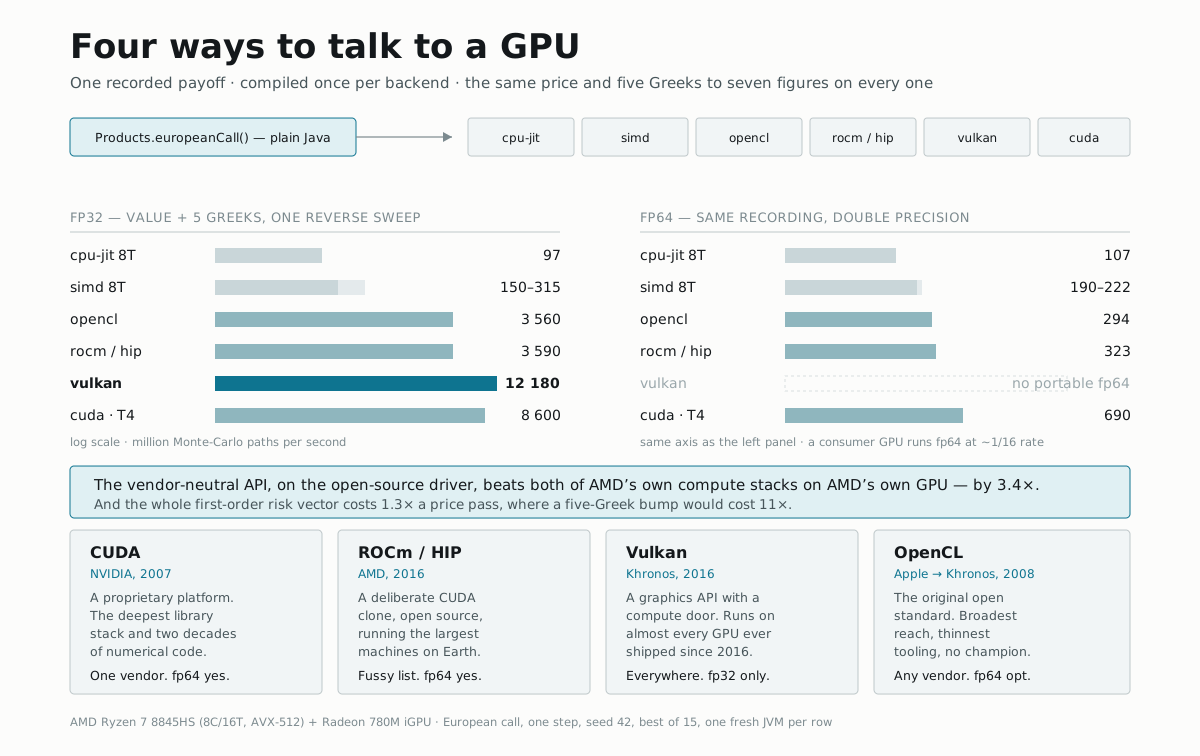
Here is the result that made this article worth writing.
On an AMD integrated GPU, running one Monte-Carlo pricing kernel, Vulkan — a graphics API, from a vendor-neutral standards body, on a driver AMD did not write — is 3.4× faster than either of AMD's own compute stacks. Not 5% faster. Three and a half times, on AMD's own silicon, against the software AMD ships specifically for this purpose.
That is not a result you can generalise into a rule, and most of this article is about why. But it is a very good reason to stop treating "put it on the GPU" as a single decision. It is at least four decisions, and the four options are not four dialects of the same language — they are four different kinds of object, with different owners, different histories, and wildly different answers to the one question a risk engine actually cares about: can I have double precision, and what does it cost me?
So: one payoff, recorded once as a tape of primitive operations, compiled into
a fused forward-plus-adjoint kernel, and run on every accelerator to hand. Two
matrices — one for fp32, one for fp64 — with 8-thread cpu-jit and 8-thread
SIMD in every row so the GPU numbers have something honest to stand next to.
Then a tour of what CUDA, ROCm, Vulkan and OpenCL each actually are, where each
came from, the history that shaped them, and which one you should reach for.
A GPU is not one thing, and neither are its APIs
Before any numbers, the orientation that most "GPU computing" writing skips. These four are not comparable objects:
| what it actually is | who owns it | |
|---|---|---|
| CUDA | a whole platform — language, compiler, runtime, libraries, profiler, debugger | NVIDIA |
| ROCm / HIP | a deliberate near-clone of that platform, aimed at different silicon | AMD |
| Vulkan | a thin, explicit driver API for the GPU as a device; compute is one thing you can ask it to do | Khronos (a committee) |
| OpenCL | a compute-only standard of CUDA's own vintage, designed to span every kind of processor | Khronos (a committee) |
The asymmetry is the point. Two of them are specifications with many implementations; two of them are implementations that happen to have a spec. That single structural difference explains most of what follows.
Underneath all four, though, sits the same machine, and it helps to know what it is. A GPU is not "a fast CPU with more cores." It is a very wide, very dumb, very patient machine:
- Lanes run in lockstep. Threads are grouped — 32 to a warp on NVIDIA, 32
or 64 to a wavefront on AMD — and the whole group executes one instruction
at a time. If half the group takes an
ifand half takes theelse, the hardware runs both halves and masks off the lanes that shouldn't have run. Branchy code wastes the machine. - Latency is hidden by oversubscription, not by caches. A CPU spends its transistor budget on out-of-order execution and a deep cache hierarchy so one thread never waits. A GPU spends it on registers, so that when one wavefront stalls on memory the scheduler simply runs a different one. The number of wavefronts it can keep resident is called occupancy, and occupancy is limited by how many registers each one needs.
- Registers are the scarce resource. This matters enormously here, and we will come back to it: an adjoint sweep roughly doubles the live values a kernel is carrying, which halves occupancy, which is why the "value + Greeks" column behaves so differently from the "price-only" column on the GPU rows.
A Monte-Carlo path is close to the ideal workload for that machine. Every path is independent, so there is no divergence and no synchronisation. The arithmetic is dense and transcendental-heavy. And — in this engine's design — the entire path lives in registers, so a hundred million paths touch almost no memory at all.
What is actually being measured
The thing being replayed is identical regardless of backend. A European call
priced by Monte Carlo, one time step, recorded once against ADouble scalars:
try (MonteCarlo<EquityMarket> mc = MonteCarlo.of(Products.europeanCall())
        .market(EquityMarket.atmOneYear())   // S0 = K = 100, sigma 20%, r 3%, T 1y
        .steps(1)
        .greeks()                            // forward pass + one reverse sweep
        .threads(8)                          // CPU engines: eight physical cores
        .on(engine)                          // "cpu-jit" | "simd" | "vulkan" | "opencl" | "rocm" | "cuda"
        .fp32()                              // or .fp64()
        .build()) {

    var v = mc.run(100_000_000L, /*seed*/ 42L);
    // v.price(), v.greek(EquityMarket::spot), ::vol, ::rate, ::strike, ::maturity
}
MonteCarlo.of(...) runs the payoff once against a recording scalar type and
flattens it into a tape — here 26 nodes. Each backend then turns that tape
into something its hardware can run, once, at build time:
| backend | the tape becomes |
|---|---|
cpu | nothing — an interpreter walks the ops[] / argA[] / argB[] arrays node by node, per path |
cpu-jit | generated straight-line Java bytecode, which HotSpot then JITs |
simd | a JDK Vector API plan over Float/Double lanes |
vulkan | GLSL → SPIR-V compute shader |
opencl | OpenCL C — a mechanical dialect rewrite of the CUDA-C source |
rocm | CUDA C, compiled by HIPRTC at runtime |
cuda | the same CUDA C string, compiled by NVRTC at runtime |
Every GPU kernel here has the same shape: one scenario per thread, a fully unrolled forward sweep followed by the adjoint sweep, both entirely in registers, with the per-scenario random stream generated in-thread by a counter-based Philox draw. A replay touches no memory beyond a handful of input scalars and one per-workgroup reduction at the end. That structure is why the reverse sweep costs so little on top of the price, and it holds on every backend below.
The OpenCL backend is forty lines of String.replace. This is not a
confession, it is a design. NVRTC and HIPRTC both accept the same CUDA-C
subset, so CUDA and ROCm already share one code generator verbatim. OpenCL C
differs from CUDA C in a small, closed set of ways — __kernel for
__global__, get_global_id(0) for blockIdx.x * blockDim.x + threadIdx.x,
__local for __shared__, barrier() for __syncthreads(), mul_hi for
__umulhi, a pointer instead of a reference for the RNG state, and OpenCL's
one-pointer sincos against CUDA's two-pointer one. So the OpenCL engine takes
the generated CUDA string and rewrites exactly those. Three backends, one code
generator, no second implementation to keep in sync — and the only
performance-motivated divergence is mapping the fp32 Box-Muller
transcendentals onto the device's hardware native_* instructions.
Vulkan is the one that needs its own generator, because GLSL is a different
language with a different set of holes. Two are worth knowing about: core GLSL
has no 64-bit integer type, so the Philox counter's 64-bit path arithmetic
is synthesised from pairs of uints with an explicit carry; and the
per-invocation accumulators are float, carried with a Kahan compensation
term, because one invocation strides over thousands of scenarios and a naive
fp32 running sum loses the low bits of every later term.
The rules of this benchmark
Enough GPU benchmarks are quietly rigged that the method deserves its own section.
- One fresh JVM per row. Running every configuration in one process
pollutes HotSpot's profiles and lets the iGPU heat-soak across rows; an
earlier single-JVM sweep understated Vulkan by ~3× and SIMD
fp32by ~2×. - Warmed hard, then best of fifteen. Six shake-out runs, a path-count ramp, twenty more warm runs at the final size, then fifteen timed runs and the best wall-clock is reported. This is the settled rate, not the cold one. (The cold-versus-settled question gets its own treatment in the 13-billion-paths piece — on an iGPU the first call after an idle period can be 40× slower than the settled rate, and that is worth disclosing rather than warming away.)
- CPU rows pinned to 8 threads. Eight physical Zen 4 cores, SMT excluded. This is deliberately not the fastest CPU configuration available — using all sixteen hardware threads is about 25% better, and that number is published below rather than hidden. Eight is the conservative comparison point: it is what one well-configured box gives you before you reach for an accelerator.
- Same seed, same path count, same tape. Every backend replays the same Philox stream path-for-path, so values can be compared with no statistical allowance at all.
- Repeated, not sampled once. Every configuration that looked at all suspicious was re-run in several fresh JVMs. One of them turned out to be bimodal, which changed what this article says about it — see the row that would not sit still.
- The machine. Every row but
cudais an AMD Ryzen 7 8845HS — 8 cores, 16 threads, AVX-512 — with a Radeon 780M (gfx1103, RDNA3) integrated on the same die. JDK 26, 512-bit vectors (16float/ 8doublelanes), Linux 7.0. Thecudarows are a Tesla T4 (2 vCPU host); the same code generator feeds both, NVRTC on one side and HIPRTC on the other. - Provenance. The CPU rows —
cpu,cpu-jit,simd, at one and eight threads, in both precisions — were measured fresh for this article. Theopencl,rocmandvulkanrows are carried over from an earlier run of the same harness a fortnight before;cudawas measured on the T4.
Throughput below is in millions of Monte-Carlo paths per second, reported twice: price-only, and value plus all five first-order Greeks from one reverse sweep.
The fp32 matrix
This is where accelerators earn the name.
| backend / config | price-only | value + 5 Greeks | Greek cost |
|---|---|---|---|
cpu-jit — generated bytecode, 8T | 171 | 97 | 1.8× |
simd — JDK Vector API, 8T | 545 | 150–315¹ | 1.7–3.6× |
opencl — Radeon 780M iGPU | ~9 000 | 3 560 | ~2.5 |
rocm / HIP — Radeon 780M iGPU | ~9 000 | 3 590 | ~2.5× |
vulkan — Radeon 780M iGPU | 15 640 | 12 180 | 1.3× |
cuda — Tesla T4 | ~38 000 | 8 600 | ~4.4× |
¹ Not a rounding range. The SIMD adjoint row is bimodal across fresh JVMs — it has its own section below.
The T4 cuda row is a discrete card on a different host — compare it to the
other GPU rows only. On this one-step kernel it trails the on-die 780M,
and that is not a fluke (I re-ran the Vulkan row on the laptop to be sure): the
tape is 26 nodes, the kernel is over in microseconds, and a discrete GPU's
per-launch cost — PCIe, driver — dominates where an integrated GPU has almost
none. Its price-only rate is still enormous (~38 000), but the adjoint sweep
costs it ~4.4× a price pass against Vulkan's 1.3× — register pressure cuts
T4 occupancy harder. Give it real work and the ranking flips: on a 252-fixing
Asian tape the T4 runs ~2× the 780M's fp32 rate.
Four things to read out of that.
Vulkan is 3.4× either of AMD's own compute stacks, on AMD's own GPU. On the
adjoint sweep — the number that matters for a risk vector — Vulkan does 12.2
billion paths a second against ROCm's and OpenCL's ~3.6 billion. The
vendor-neutral API, running on Mesa's open-source RADV driver, beats the
vendor's own HIP and OpenCL runtimes on this kernel by a wide margin. This is
an integrated-GPU, consumer-driver result and it would not necessarily hold on
an Instinct card with a tuned ROCm build. But on the hardware most people
actually have in front of them, it is the pattern — and it is a pattern people
outside finance keep rediscovering too. In the local-LLM world, llama.cpp's
Vulkan backend regularly trades wins with ROCm on consumer AMD parts, sometimes
decisively, depending on the phase of the workload.
Why would the committee standard win? Three reasons that have nothing to do
with API design and everything to do with where the engineering went. First,
the Vulkan compute path is thin: you hand the driver a SPIR-V module and a
dispatch, and there is almost nothing between your kernel and the shader cores
— where ROCm and OpenCL both reach the device through the heavier HSA queue
machinery in amdkfd. Second, the shader compiler. RADV's back-end, ACO, was
written and is maintained largely by Valve, because every game on the Steam
Deck depends on it; it is one of the most exercised compilers in the Linux
graphics stack. Third, and bluntly: on a gfx1103 APU, RADV's compute path
runs a large fraction of the games on Steam, and ROCm runs approximately
nothing. Testing volume is a performance feature.
The GPU price-only numbers are noisy; the adjoint numbers are not. The iGPU ramps its clock hard for the lean price-only kernel — best-of-fifteen caught it anywhere from 6 to 9 billion paths a second for OpenCL and ROCm across repeats — while the register-heavier adjoint kernel is occupancy-bound and sits steady near 3.6 billion. That is why the OpenCL and ROCm "Greek cost" column reads ~2.5× rather than Vulkan's 1.3×: it is the price-only number that ran away, not the sweep that got slower. This is the register-pressure story from the primer, showing up as a measurement artefact.
fp32 does nothing at all for cpu-jit. The price-only figure is 171 in
single precision and 171 in double — identical to the digit, which is the tell.
The generated bytecode kernel widens float to double on the JVM operand
stack anyway, so narrowing the declared type only adds conversions. The JVM
has no float fast path in the way the hardware does; a float on the JVM is
a storage format, not an execution mode.
fp32 buys SIMD about 1.2× on the price pass — 545 against fp64's ~460 —
which is roughly what you would expect from sixteen float lanes in a 512-bit
vector against eight double lanes, minus the transcendentals that do not
narrow as cleanly. The adjoint column is a different story, and it gets its own
section.
The fp64 tax, and why finance keeps paying it
Before the second matrix: the single most useful fact about GPUs that quantitative people tend to learn the expensive way.
Double precision on a GPU is a product-segmentation decision, not a physics
one. Vendors run fp64 at whatever fraction of the single-precision rate the
market segment justifies:
| hardware class | fp64 : fp32 rate | in practice |
|---|---|---|
| NVIDIA data-centre (A100, H100, and successors) | 1 : 2 | full-speed double; what HPC buys |
| AMD Instinct MI250X | 1 : 1 | vector fp64 at the fp32 rate |
| AMD Instinct MI300X | 1 : 2 | full-speed double |
| AMD consumer Radeon / this 780M | ~1 : 16 | usable, not fast |
| NVIDIA consumer GeForce (RTX) | 1 : 64 | deliberately crippled |
| Apple M-series GPU | none | Metal has no double type at all |
| Vulkan, portably | none | shaderFloat64 is an optional feature |
So a fp64 Monte Carlo on a gaming card is running on about 6% of the silicon,
and on an Apple GPU it is not running at all. This is not an accident of
manufacturing — the same die, sold as a data-centre part, would do it at half
rate.
A curiosity. The most-loved GPU in the history of computational science was
probably the GTX Titan (2013): a consumer card, sold at consumer prices,
that NVIDIA shipped with fp64 at 1/3 of fp32 — near-Tesla double
precision for a fraction of a Tesla's price. Research groups bought them by the
crate. NVIDIA has never repeated the mistake; every GeForce since has been
locked to 1/32 or 1/64, and in 2017 the GeForce driver licence was amended to
forbid data-centre deployment outright. Segmentation, once discovered, does not
get un-discovered.
The finance angle is that fp64 is usually not negotiable. Not because Monte
Carlo needs fifteen significant figures — it emphatically does not; the
sampling error at a hundred million paths swamps float rounding by orders of
magnitude — but because a number that goes into a regulatory capital
calculation has to be reproducible and defensible, and "we ran it in single
precision" is a conversation nobody wants to have with a model-validation team.
Whether that instinct is right is a real debate. The matrices let you cost it.
The fp64 matrix
Same recording, same seed, .fp64().
| backend / config | price-only | value + 5 Greeks | Greek cost |
|---|---|---|---|
cpu — scalar interpreter, 8T | 87 | 48 | 1.8× |
cpu-jit — generated bytecode, 8T | 171 | 107 | 1.6× |
simd — JDK Vector API, 8T | 442–487 | 190–222 | 2.2–2.5× |
opencl — Radeon 780M iGPU | 360 | 294 | 1.2× |
rocm / HIP — Radeon 780M iGPU | 404 | 323 | 1.3× |
vulkan | fp32 only — no portable fp64 in SPIR-V | ||
cuda — Tesla T4 | ~1 000 | 690 | ~1.5× |
The read-out:
On an integrated GPU, fp64 is barely a GPU workload. ROCm and OpenCL land
at 300–400 Mpath/s — level with the fastest CPU configuration's price-only
rate. Against cpu-jit on the adjoint sweep it is about 3×: real, but not the
kind of number anyone buys hardware for. The whole 1:16 tax is visible in that
one comparison. On a discrete data-centre card the ratio changes completely,
and the fp32 column shows what the same silicon does when you let it use its
full width.
cpu-jit is the number to beat if you cannot ship a native dependency.
171 / 107 Mpath/s on a stock LTS JDK: no incubator module, no driver, no .so,
no container gymnastics. Every GPU row above needs a working Vulkan or ROCm
userspace on the deployment box. This one needs Java.
The Greek sweep costs about 1.6–1.8× a price pass on CPU and 1.2–1.3× on the
GPU — never the ~11× a five-Greek central bump would cost (1 + 2×5 full
repricings). That is the adjoint-AD payoff from the
bump-and-revalue post, and the striking
thing is that it survives every backend switch. Changing where the tape runs
changes the throughput by two orders of magnitude and leaves the
adjoint-versus-bump ratio essentially alone.
The interpreter earns its keep by being slow. cpu walks the tape node by
node instead of compiling it, and pays about 2× for the privilege (87 / 48
against cpu-jit's 171 / 107). It is not in the table to be fast. It is in the
table because it is the bit-exact oracle every other backend gets checked
against — which is the subject of the next section.
CUDA and OpenCL on the Tesla T4
Two notes on the cuda rows above — same workload and unit as every other row,
just a different machine.
CUDA and its OpenCL shim are level. 8 600 against 8 550 Mpath/s at fp32,
690 against 660 at fp64. NVIDIA's OpenCL is a thin layer over the same driver,
and on a 26-node kernel the layer costs next to nothing. It is the AMD result
inverted and shrunk: on NVIDIA the vendor stack is ahead by a hair, never the
3.4× the open API opened on AMD. The gap widens on heavier tapes, where the
mature toolchain has more to compile against.
cuda does real fp64, where the fp64 matrix leaves vulkan blank —
SPIR-V has no portable double. The T4 runs it at about a twelfth of its
fp32 scenario rate, well short of the tax raw FLOP ratios predict, because the
kernel is launch- and occupancy-bound rather than double-precision-FLOP-bound.
The row that would not sit still
The simd adjoint figures above are ranges, and honesty about why is worth
more than a tidy number.
Running the same 8-thread SIMD configuration six times, each in its own fresh
JVM, warmed identically, best-of-fifteen each time, fp32, value + 5 Greeks:
147   314   177   303   304   311      Mpath/s, value + 5 Greeks
548   536   551   545   548   543      Mpath/s, price-only, same six runs
That top row is not noise. Noise is a spread around a mean. This is bimodal: every run lands either near 165 or near 310, nothing in between, and whichever one it picks it holds for the whole life of that JVM. The price-only row underneath, from the same six processes, is boringly stable inside 3%. So it is not thermal, not the scheduler, and not the measurement harness — it is something about how the adjoint kernel specifically gets compiled.
A ~1.9× cliff that is decided once per process and then never moves is the
classic signature of a Vector API intrinsification failure: when a hot
method grows past HotSpot's inlining budget, FloatVector operations stop
being compiled to single AVX-512 instructions and fall back to allocating boxed
vector objects on the heap. The adjoint kernel is exactly the method that would
be on that boundary — it is roughly twice the size of the price-only one,
because it carries the reverse sweep. Whether C2 gets under the budget on a
given run appears to depend on the order it happens to compile things in.
That is a hypothesis, not a confirmed diagnosis — nailing it down means reading compilation logs, which is a different article. Two things are certain enough to act on:
- The published range is real and both ends of it happen. An earlier draft
of this comparison reported the
fp32adjoint row as a single stable figure near 300 and asserted that only thefp64path wobbled. Six repeats showed that was luck, not stability — and, incidentally, that thefp64adjoint row it had flagged as wildly unstable is the steadier of the two today (190–222 across six runs). A benchmark you have run once is a benchmark you have not run. - The fastest CPU engine is also the least predictable one, and that is a
deployment fact.
simdatfp32is somewhere between 1.7× and 3.2×cpu-jiton the adjoint sweep, and you do not get to choose which.cpu-jitis slower and lands on 107 every single time. For a nightly batch, take the speed. For a latency budget with a number in a contract, take the one that does not have a cliff in it.
Threads, and why the tables say eight
Every CPU engine splits the path range across .threads(n) workers, and every
CPU row above uses eight — the eight physical Zen 4 cores, SMT excluded.
That is a deliberate choice, and it is worth being explicit that it is not the
fastest choice. Letting the same kernel take all sixteen hardware threads is
measurably better, and the number belongs in the article rather than in a
footnote (cpu-jit, fp64, Mpath/s):
| threads | price-only | value + 5 Greeks |
|---|---|---|
| 1 | 24 | 15 |
| 8 — physical cores | 171 | 107 |
| 16 — with SMT | 205 | 134 |
So simultaneous multithreading buys about 25% on top of the physical cores. This kernel has enough transcendental and dependency latency in it that a second thread per core does find work to do — the intuition that a dense floating-point loop gets nothing from SMT turns out to be wrong here, which is exactly the sort of thing worth measuring rather than assuming.
simd gains from SMT too, and more interestingly: at fp32, sixteen threads
gave 654 price-only and 369 on the adjoint sweep — better than even the
good half of the bimodal 8-thread distribution.
Eight is in the tables anyway, for two reasons. It is the number that transfers to a sized production box, where you rarely get to assume an idle machine. And it is the conservative side of the comparison to be making: quoting a GPU speedup against a CPU baseline you have not maximised is how benchmarks flatter themselves. If you would rather read the accelerator ratios against a fully loaded CPU, divide them by about 1.25.
Scaling from a single core is close to linear, which is what a workload with no
shared state should look like — every path is independent, the only
synchronisation is one reduction at the end (fp64, value + 5 Greeks):
| engine | 1 thread | 8 threads | scaling |
|---|---|---|---|
cpu — interpreter | 7 | 48 | 6.9× |
cpu-jit | 15 | 107 | 7.1× |
simd | 33 | 190–222 | 5.8–6.7× |
cpu-jit also takes an opt-in optimisation level (JitOptimizations.Level.LOW_RISK,
which detects a prologue · body×N · epilogue tape and emits a rolled bytecode
loop instead of a flat unrolled one). On this payoff it measured 170 / 105
against the default's 171 / 107 — a wash, because a 26-node single-step tape is
already tiny. It is worth a lot on a 252-step Asian. Every number in these
tables is the default code generator, which is also the one that stays
bit-identical to the interpreter.
Do the numbers agree?
A speedup is worthless if the fast path computes a different number. Because
every backend replays the same tape against the same Philox stream
path-for-path, at an equal seed and an equal path count the results can be
compared with no statistical allowance whatsoever — any difference is
arithmetic reordering, not sampling noise. At 20 million paths, seed 42:
backend        precision   price          delta        vega
cpu-jit        fp64        9.4122353      0.5986992    38.660793
simd           fp64        9.4122353      0.5986992    38.660793
opencl         fp64        9.4122353      0.5986992    38.660793
rocm  / HIP    fp64        9.4122353      0.5986992    38.660793
cuda           fp64        9.4122353      0.5986992    38.660793
cpu-jit        fp32        9.4122351      0.5986992    38.660789
simd           fp32        9.4122351      0.5986991    38.660790
vulkan         fp32        9.4122346      0.5986992    38.660787
opencl         fp32        9.4122343      0.5986991    38.660787
rocm  / HIP    fp32        9.4122343      0.5986991    38.660787
cuda           fp32        9.4122330      0.5986993    38.660776
The fp64 backends are bit-identical: generated Java bytecode, a Vector API
plan, a HIPRTC-compiled HIP kernel, an OpenCL kernel and an NVRTC-compiled CUDA
kernel all land on the same 9.4122353. The fp32 rows differ from fp64 only
in the sixth or seventh significant figure — float rounding in the per-path
arithmetic — and note that the reduction accumulators stay in double on every
backend, so that error does not grow with path count. There is no backend
here whose price you would not trust to five figures, and none whose Greeks
disagree past the sixth.
That is worth dwelling on for a second, because it is the argument for keeping a deliberately slow reference implementation around forever. The fast kernels are not trusted; they are checked.
How this section was wrong the first time. An earlier draft reported ROCm and OpenCL as carrying a systematic bias of a few parts in ten thousand. That was a measurement mistake: the GPU probes had been run at a smaller path count than the reference, so the gap was ordinary Monte-Carlo convergence — fewer paths, a noisier mean — and not a backend difference at all. Re-run at an identical 20 million paths, everything reconciles to seven figures. The lesson is boring and universal, and it has bitten better benchmarks than this one: compare throughput at whatever path count you like, but only ever compare values at the same one.
CUDA — the one with the ecosystem
CUDA is NVIDIA's proprietary parallel-computing platform: a C/C++ dialect with
__global__ kernels, a runtime, a profiler, a debugger, and — the part that
matters for a record-and-replay engine — NVRTC, a library that compiles
kernel source to GPU code at runtime with no external toolchain on the box. It
runs only on NVIDIA hardware, and that is the deal. In exchange for the
lock-in you get the most mature compiler, the deepest library stack (cuBLAS,
cuDNN, cuRAND, Thrust, and a hundred others), and the better part of two
decades of numerical-computing projects that targeted it first and everything
else, if ever, afterwards.
In finance specifically, CUDA has a long incumbency, and one press release did much of the work. In August 2011 NVIDIA announced that J.P. Morgan's Equity Derivatives Group had moved more than half its risk computation onto Tesla M2070 cards and was seeing a 40× end-to-end speedup — risk calculations "in minutes, not hours", and an 80% cut in the cost of running them. That story, repeated at every quant conference for a decade, is a large part of why "GPU" and "CUDA" became synonyms on trading floors. (NVIDIA's announcement.)
A little history. CUDA's ancestor is Brook, a 2003 Stanford research language led by Ian Buck that extended C with data-parallel constructs and compiled them down to what GPUs of the day could actually do — which was to run a tiny program over every pixel, a million pixels, sixty times a second. Before that, "GPGPU" meant disguising your mathematics as texture lookups and shader tricks and hoping the driver did not notice. NVIDIA hired Buck in 2004 and paired him with John Nickolls to turn Brook into a product.
The hardware precondition arrived in November 2006 with the GeForce 8800 GTX (the G80 chip): 128 shader units unified into one programmable array, replacing the separate vertex and pixel pipelines every prior GPU had. That unification is what made general-purpose GPU computing possible at all. CUDA shipped publicly in 2007. It originally stood for "Compute Unified Device Architecture"; NVIDIA quietly dropped the expansion and now just calls it CUDA.
The strategic move, though, was not technical. NVIDIA put CUDA on the cheap consumer GeForce cards, not only on the expensive professional ones. Every graduate student with a gaming PC suddenly had a parallel supercomputer and a free toolkit. The moat everyone talks about now was dug one PhD thesis at a time, over fifteen years, and it is made of people rather than of silicon.
The moat has lawyers. Since 2021 NVIDIA's CUDA licence has forbidden running compiled CUDA programs on non-NVIDIA hardware through a translation layer. In 2024 that clause was moved out of the online EULA and into a text file shipped inside the toolkit itself, where you cannot miss it. The obvious target was ZLUDA — a drop-in CUDA implementation by Andrzej Janik, funded first by Intel and then, from 2022, by AMD, which let unmodified CUDA binaries run on Radeon hardware through HIP. AMD had the code released as open source in early 2024, then asked for it to be taken down again a few months later rather than test the licence in court. ZLUDA has since restarted as an independent project. Whatever else it is, it is a rather precise measurement of how much the ecosystem is worth.
Sources: Tom's Hardware on the EULA change, The Register on the AMD takedown.
Pick CUDA when your deployment hardware is NVIDIA and you want the library
ecosystem, the profiler, and the path every piece of documentation assumes. If
you need fp64 at full rate, this is also — with AMD's Instinct line — one of
only two places to get it.
ROCm / HIP — AMD's answer, deliberately CUDA-shaped
ROCm is AMD's open-source GPU-compute stack; HIP is its kernel language,
and HIP is a near-clone of CUDA C entirely on purpose. A hipify tool does most
of the mechanical translation from CUDA source, and AMD's claim is that 90%+ of
a typical CUDA codebase converts automatically. This engine leans on that
directly and about as hard as it is possible to lean: the ROCm backend feeds
the same generated CUDA-C string the CUDA backend uses straight into
HIPRTC, ROCm's runtime compiler, with no modification at all. One code
generator, two vendors.
A little history. ROCm grew out of AMD's "Boltzmann Initiative,"
announced at Supercomputing 2015 and named after Ludwig Boltzmann — whose
entropy formula, S = k · log W, is carved on his gravestone in Vienna. It is
an unusually literary name for a driver stack. The first deliverables were a
heterogeneous compute compiler, a headless Linux driver, and HIP, the
CUDA-portability layer. It was productised as ROCm, the Radeon Open Compute
platform, and the whole thing was open-sourced — which is more than the
incumbent has ever done.
It runs the world's biggest machines and not the developer's laptop. ROCm
powers Frontier at Oak Ridge — the first machine to break an exaflop, in
2022 — and El Capitan at Livermore, which took the number-one spot in 2024.
Both are AMD Instinct systems. And for years, the same stack would refuse to
install against a consumer Radeon card, because AMD's officially supported-GPU
list is short and consumer parts mostly are not on it. The folk remedy,
HSA_OVERRIDE_GFX_VERSION, is a magic environment variable that lies to the
runtime about which architecture it is looking at, and half the AMD
machine-learning internet runs on it.
The public low point was 2023, when tinygrad's George Hotz spent months
livestreaming himself debugging AMD driver faults, filing kernel bugs, and
periodically threatening to drop AMD support altogether. It got fixed faster
after that. The gap between "powers the number-one supercomputer" and "does not
admit my GPU exists" has narrowed since, but it is still the defining fact
about ROCm on consumer hardware. The ROCm rows above are real HIP kernels on a
gfx1103, and they only exist because the engine was told, explicitly, to
ignore its own supported-architecture denylist.
Pick ROCm when you are on AMD data-centre hardware or one of the officially
supported Radeon cards, and you want fp64 on the device with a CUDA-like
programming model. It is the only route to full-rate double precision that
isn't NVIDIA.
Vulkan — the portable one that was a graphics API first
Vulkan is a Khronos open standard, and unlike the other three it is not primarily a compute API at all. It is a low-level graphics-and-compute API that happens to expose compute shaders. You write the kernel in GLSL (or any language with a suitable compiler), compile it to SPIR-V — a portable binary intermediate representation — and hand that to the driver.
The payoff is reach. The same SPIR-V runs on NVIDIA, AMD, Intel, Apple through MoltenVK, Android phones, the Steam Deck, a Raspberry Pi, and a CPU software rasteriser for CI machines with no GPU at all. Anything with a Vulkan driver, which by now is very nearly everything.
A little history: Mantle, "glNext", and a name chosen to forget OpenGL. Vulkan started life as Mantle, a low-overhead graphics API AMD built with DICE (the Battlefield studio), announced in 2013 and shipping in games the following year, to prove that the driver overhead everyone had accepted for twenty years was optional. Apple's unveiling of Metal at WWDC 2014 made it clear the whole industry was moving to thin, explicit APIs, and OpenGL — by then a quarter-century of accumulated compromise — was not going to get there by amendment. AMD donated Mantle to Khronos in 2015 as the starting point.
Khronos worked under the placeholder name "glNext", which was widely misread as a promise that the result would be OpenGL-shaped. It very much was not: Vulkan hands you explicit control of memory, synchronisation and command buffers, and validates nothing at runtime unless you ask it to. The rename was announced at GDC 2015 specifically so nobody would expect a sequel, and 1.0 shipped in February 2016. "Vulkan" is not an acronym and does not stand for anything.
The last twist is the funniest one. Apple, whose Metal announcement helped trigger all of this, never shipped Vulkan. Instead a translation layer called MoltenVK maps Vulkan onto Metal — and Khronos ended up formally blessing it, so "portable to Apple" is true by way of a shim over the API that made Vulkan necessary.
The side door ate the building. Vulkan's compute pipeline exists because games needed particle systems, culling and post-processing — compute was a supporting feature for the graphics work, not the point. Two things then happened that nobody planned.
The first is SPIR-V. Khronos needed one binary format that every driver could consume, so shader source would stop being compiled by fifty subtly different vendor front-ends at runtime — a decade of "this shader works on NVIDIA and miscompiles on AMD" bugs. SPIR-V is that format, and because it is a generic SSA intermediate representation rather than a graphics one, it turned out to be a perfectly good compute target. OpenCL adopted it too. It is now the closest thing the industry has to a neutral GPU bytecode.
The second is that the machine-learning world discovered compute shaders were
the only truly portable way to reach a GPU. llama.cpp's Vulkan backend runs
large language models on AMD, Intel, NVIDIA, Apple and Android phones from one
code path, and on consumer AMD hardware it frequently matches or beats ROCm —
which side wins depends on the phase of the workload and the generation of the
part, but that a graphics API is in the fight at all is the remarkable bit.
The pattern in the fp32 table above is the same pattern, on a different
workload.
For this engine the practical consequence is dependency weight. The Vulkan
backend dlopens exactly two libraries through Java's foreign-function API —
the vendor-neutral loader libvulkan.so.1 and the runtime GLSL compiler
libshaderc.so.1 — and links against no vendor SDK, ships no JNI, and bundles
no native jar. In a container that is a few megabytes next to ROCm's tens of
gigabytes. The catch, and it is a real one: shaderFloat64 is an optional
Vulkan feature, so there is no portable double precision here. Vulkan is
fp32, by design and by the nature of the target surface.
Pick Vulkan when you want one GPU path that runs on whatever hardware the
user happens to have, fp32 is acceptable, and you do not want a vendor
toolchain in your build or your container. On the numbers above it is also, by
a wide margin, the fastest thing available.
OpenCL — the original open standard, still everywhere and nowhere
OpenCL is the oldest of the four: a Khronos standard for writing kernels in a C dialect that run on CPUs, GPUs, FPGAs and DSPs from any vendor. The promise was write-once-run-anywhere compute — CUDA's capability without CUDA's collar, arriving barely a year after CUDA itself.
The reality is that runtime quality varies enormously by vendor, fp64 and
most interesting features are optional extensions you have to query for at
runtime, and the tooling never got a fraction of the investment CUDA did. It is
still the most broadly supported option — if you need to span an old Intel
iGPU, an AMD card and an NVIDIA card with one binary, OpenCL is often the only
thing that works at all — and it remains the only vendor-neutral route to
double precision on a GPU.
A little history. OpenCL was started by Apple in 2008, developed with AMD, IBM, Qualcomm, Intel and NVIDIA, and handed to Khronos, which shipped 1.0 inside the same year; the lead spec editor, Aaftab Munshi, was at Apple. The irony is sharp and well earned: Apple, which created OpenCL, deprecated it on macOS in 2018 alongside OpenGL, in favour of its own Metal. NVIDIA, meanwhile, supported OpenCL but was in no particular hurry to make it fast or current while CUDA was the reason to buy its cards.
The standard that unshipped its own version. OpenCL 2.0 (2013) added shared virtual memory, device-side enqueue and pipes — genuinely ambitious features that were also genuinely hard to implement. NVIDIA simply never shipped it, sitting on 1.2 for the better part of a decade. Rather than watch the spec become fiction, Khronos did something almost unheard of: OpenCL 3.0, in 2020, redefined the required baseline as OpenCL 1.2, and made every single 2.x feature optional. A conformant OpenCL 3.0 implementation is allowed to be, feature for feature, an OpenCL 1.2 implementation with a new version string.
That is either a humiliating retreat or an honest admission that a standard nobody implements is worth nothing, depending on who you ask. What is not in dispute is where the energy went: into SPIR-V as the shared intermediate representation, and into SYCL — single-source C++ over OpenCL-class devices — which is now the front-end of Intel's oneAPI.
Pick OpenCL when portability across vendors matters more than peak
performance and you need fp64 on a GPU that is neither NVIDIA nor a
supported-ROCm AMD part. Here the OpenCL device is AMD's own HSA-based runtime
on the gfx1103; it works, it reconciles to seven figures, and on the adjoint
sweep it lands at roughly a third of Vulkan — which
is still an order of magnitude over the best CPU configuration.
cpu-jit and simd — why the GPU rows have context
Neither is an accelerator API, and both stay in every table on purpose.
cpu-jit is the tape compiled to plain Java bytecode. No native library, no
driver, no incubator module, no container changes; it runs on any LTS JDK and
does 107 Mpath/s of full risk vector on eight cores in fp64, 97 in fp32. It
is the floor — and, across every repeat run in this article, the single most
predictable number in any of the tables. For a great many real workloads the
floor is enough.
simd is the same tape mapped onto the JDK Vector API — still pure JVM,
still no native code, one --add-modules jdk.incubator.vector flag — and at
fp32 it does 150–315 Mpath/s with the adjoint sweep, or 1.7–3.2× cpu-jit
depending on which side of the cliff that
JVM landed on. On the price pass, where it is stable, it is a clean 3.2×.
The AMD GPU compute stacks are roughly 12–24× the SIMD adjoint number at
fp32; Vulkan is roughly 40–80×. Whether that gap matters depends entirely on whether another
order of magnitude of "already fast enough" is worth a driver dependency in
production. For a nightly risk batch it very much is. For a pricing service
that answers in 20 ms and spends most of that waiting on the network, it very
much is not — and shipping a JAR that runs anywhere has a value that does not
appear in any of these tables.
And the tape itself is not a tax. It is fair to ask what all the
recording-and-compiling machinery costs against just writing the Monte-Carlo
loop by hand. Measured: a hand-written Java for-loop over double, same RNG,
same model step, no tape, does 191 Mpath/s price-only on 8 threads; the
generated cpu-jit kernel does 171. Within about 10%, and the
recording plus code generation is a one-off ~11 ms, not a per-run cost.
Hand-coding the five pathwise derivatives is faster still — 182 against 107 —
but you write and maintain those five lines for every new payoff, and a barrier
or a digital will punish a mistake in them silently. The tape's adjoint is
exact for anything you can express, on any of six backends, from one recording.
Pros and cons, on one screen
| CUDA | ROCm / HIP | Vulkan | OpenCL | simd | cpu-jit | |
|---|---|---|---|---|---|---|
| Vendors | NVIDIA only | AMD only | all GPUs | all vendors | any CPU | any CPU |
fp64 on device | yes, full rate on DC parts | yes, full rate on Instinct | no (optional feature) | optional extension | yes | yes |
| Runtime kernel compile | NVRTC | HIPRTC | GLSL → SPIR-V | driver | n/a (JIT) | n/a (JIT) |
| Native dependency | CUDA driver | ROCm userspace | Vulkan loader + shaderc | ICD loader | none | none |
| In a plain container | toolkit needed | ~20 GB stack, or a hand-staged subset | two .sos, a few MB | ICD, tiny | nothing | nothing |
| Library ecosystem | vast | growing, CUDA-shaped | none for compute | thin | — | — |
| Tooling / profiler | best in class | decent, improving | graphics-oriented | poor | JFR, async-profiler | JFR, async-profiler |
| Run-to-run stability | — | price-only noisy | good | price-only noisy | bimodal (see above) | excellent |
fp32 val+5G (Mpath/s) | 8 600 | 3 590 | 12 180 | 3 560 | 150–315 | 97 |
fp64 val+5G (Mpath/s) | 690 | 323 | — | 294 | 190–222 | 107 |
So which one should you actually use?
- Shipping to the JVM with no native dependency at all:
cpu-jit. It needs nothing, and ~107 Mpath/s of full risk vector on a modest CPU is enough for a great many real workloads. - CPU throughput without a driver, and you can add one JVM flag:
simdatfp32. Up to ~3×cpu-jit, still pure Java — but read the bimodality section first if you are sizing a latency budget rather than a batch window. - One GPU path that runs on whatever hardware is in the box, and
fp32is acceptable: Vulkan. Portable, tiny dependency, no vendor toolchain — and on this evidence frequently the fastest thing available anyway. - You are on NVIDIA and want the ecosystem, the profiler and full-rate
fp64: CUDA. Nothing else gives you the libraries. - You are on supported AMD hardware and need device
fp64: ROCm. On Instinct parts it is the fastest double precision money can buy. - You must span vendors — some Intel, some AMD, some NVIDIA — with one build,
and need device
fp64: OpenCL, eyes open about the performance ceiling and the tooling.
The genuinely nice property of a record-and-replay design is that this is a one-word decision, made at deployment time, rather than an architectural commitment made at the start of the project. The tape does not know or care which of these ends up executing it — and, as the reconciliation table shows, neither does the answer.
Try it yourself
git clone https://github.com/nablatensor-dev/nablatensor && cd nablatensor
mvn -o -q compile

# every backend with a driver present, side by side (fp64)
MAVEN_OPTS="--add-modules jdk.incubator.vector" mvn -o -q -pl nablatensor-examples exec:java \
  -Dexec.mainClass=com.nablatensor.examples.AsianGreeksBackends -Dscenarios=2000000 -Dsteps=252

# the European-call showpiece, pinned to one backend at a time
mvn -o -q -pl nablatensor-examples exec:java \
  -Dexec.mainClass=com.nablatensor.examples.BlackScholesBothWays -Dengine=cpu-jit   # or simd / vulkan / opencl
The two matrices in this article come from a smaller harness that runs exactly
one configuration per JVM — OneCfg.java, in the engine repo's
docs-internal/bs-perf/ — because, as the SIMD section shows, sharing a JVM
between configurations is how you publish a number that is not there:
CP="$(find . -path '*/target/classes' -type d | tr '\n' ':')"
java -cp "$CP" --enable-native-access=ALL-UNNAMED --add-modules=jdk.incubator.vector \
  --source 25 docs-internal/bs-perf/OneCfg.java cpu-jit fp64 8     # engine, precision, threads
AsianGreeksBackends loops over availableEngines() — cpu, cpu-jit, and
whichever GPU backends have a working userspace. To stay on the CPU, pin one
backend with .on("cpu-jit"). GPU setup notes are in
docs/install/vulkan.md
and docs/install/rocm.md.
The simd engine needs --add-modules jdk.incubator.vector, because the JDK
Vector API is still an incubator module. Everything else — the cpu-jit
numbers, the whole reconciliation check, the cpu oracle — runs on a stock LTS
JDK with no native library and no GPU of any kind.