Forget, then remember: checkpointing on a GPU
Why a GPU's Greeks pass can cost eight times its price pass when a CPU's costs less than two, and how throwing away most of a path's forward values and recomputing them fixes it.
The 252-step Asian tape from Module 3 costs a CPU only 1.7× more to get all five Greeks instead of just the price. On a GPU, the same tape costs 8×. Same tape, same arithmetic, same reverse sweep. Where did the other 6× go?
The whole story
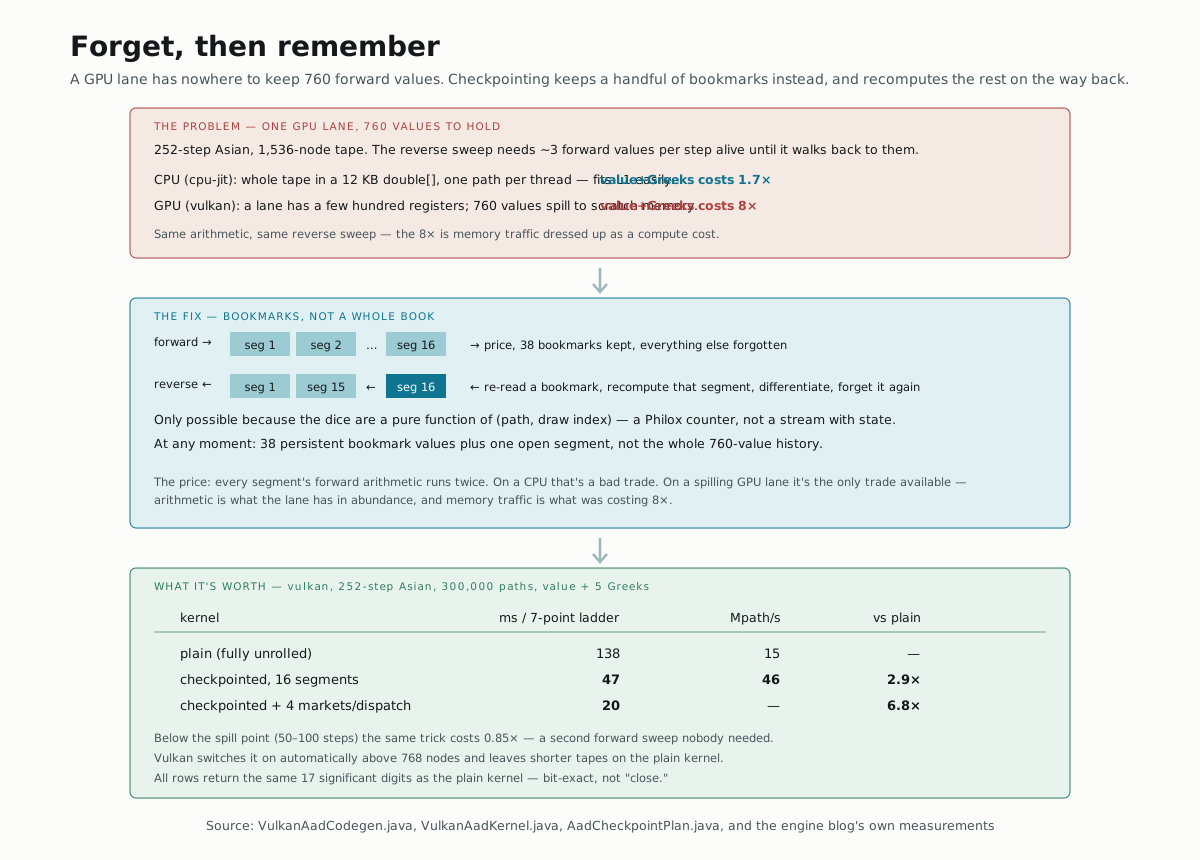
Recomputing a segment only works because NablaTensor's GPU kernels draw
randoms from Philox, a counter-based generator: draw k of path p is
a pure function of (p, k), not the next value pulled from some mutable
stream state. Re-running a segment's forward arithmetic a second time asks
for the same draws by index and gets bit-identical numbers back, with
nothing saved anywhere for the random stream itself. A stateful generator
would need that state checkpointed too, at every cut — and the memory
saving would be a fraction of what it is.
Why a CPU doesn't notice and a GPU can't ignore it
The reverse sweep needs some of the forward sweep's intermediate values
back — an exp node needs its own output; a multiplication needs both its
inputs. Add that up over 252 time steps and it comes to roughly 760
forward values a plain kernel has to keep alive from the moment they're
computed until the reverse sweep, hundreds of nodes later, reads them.
cpu-jit keeps the whole tape in a 12 KB double[], one path at a time
per thread — a fraction of an L1 cache. A GPU lane gets, at best, a few
hundred registers, shared across however many paths the scheduler is
running at once. Ask it to hold 760 values and the compiler spills the
overflow to scratch memory; every lane doing that at once turns the
reverse sweep into a memory workload wearing an arithmetic costume. That's
the 8×.
Two checkpointing strategies, one engine
nablatensor-core's AadCheckpointPlan cuts a tape into fixed-length
segments — the actual, current algorithm is plainer than it might sound:
int segLen = Integer.getInteger("nablatensor.checkpoint.segLen",
    Math.max(48, (int) Math.round(Math.sqrt(n))));
int segCount = (n + segLen - 1) / segLen;
For the 1,536-node Asian tape: segLen = max(48, round(√1536)) = max(48, 39) = 48, so segCount = 1536 / 48 = 32 — evenly spaced cuts, no attempt
to find a cheaper one nearby.
AadCheckpointPlan.java's own class doc says it is "shared by the CUDA
and Vulkan adjoint code generators." It isn't, anymore — VulkanAadCodegen .emitCheckpointed never references AadCheckpointPlan at all. It has its
own, separate cut-selection loop that searches a window around each evenly
spaced target for the position where the fewest values are still live,
and only CudaAadCodegen.generateCheckpointed — shared by cuda,
opencl, and rocm — actually takes an AadCheckpointPlan and uses its
plainer fixed-length segments. Two genuinely different strategies live in
one engine, and only one of them is named in the class comment that
describes both.
What it's worth
This part is Vulkan's own numbers, from the engine's blog article on exactly this technique — the same 252-step Asian tape, 300,000 paths, value plus five Greeks, measured as the median of three seven-point spot ladders:
| kernel | ms / 7-point ladder | Mpath/s | vs plain |
|---|---|---|---|
| plain (fully unrolled) | 138 | 15 | — |
| checkpointed, 16 segments | 47 | 46 | 2.9× |
| checkpointed, 4 markets/dispatch | 20 | — | 6.8× |
Every row returns the same price and Greeks to all seventeen significant digits — not "close," bit-exact, because every recomputed value is the same instructions on the same inputs the first pass already produced. Below the spill point (50–100 time steps) the same trick costs 0.85×, which is why Vulkan only turns it on automatically above 768 nodes.
Try it yourself
Using segLen = max(48, round(√n)), work out whether checkpointing would
even apply to any tape this Learn section has built so far. 1.3's European
call: 26 nodes. 3.1's Asian call at 252 steps: 1,536 nodes. AadCheckpoint Plan.of refuses to build a plan at all below its minNodes threshold —
every tape before this page, including the 1,536-node one on cpu-jit or
cpu, never goes near this code path, because it's the CUDA/OpenCL/ROCm
codegen only, and the tape has to run on one of those three engines for
AadCheckpointPlan to matter at all.
▶️ Run it
This one needs a GPU this book's other pages didn't — nothing here runs on
cpu-jit. The command, for a machine with a Vulkan-capable device:
mvn -o -q install
mvn -o -q -pl nablatensor-examples exec:java \
  -Dexec.mainClass=com.nablatensor.bench.CheckpointBench \
  -Dengine=vulkan -Dsteps=252 -Dscenarios=300000 -Dmode=checkpointed
Nothing to switch on beyond the engine name — a tape of 768 nodes or more
gets the checkpointed sweep automatically on vulkan.
⚠️ What this doesn't do
This page only covers vulkan's register-only checkpointing in depth. The
cuda/opencl/rocm path this page's second sidenote points at has its
own, separate story — a scratch-buffer layout bug and a mistuned segment
length, diagnosed but, per the source article, not yet merged into the
engine as shipped — left for the deeper link below. It also doesn't cover
sharing random draws across a whole revaluation ladder in one GPU
dispatch, a related but different trick from the same article.
What's next
→ Deeper: Forget, then remember: checkpointing the adjoint sweep on a GPU has the full derivation, the register-spill cliff chart, the compiler- merging bug that needed an XOR to defeat, and the unmerged CUDA/OpenCL/ROCm fix this page only named. → Next: Four ways to talk to a GPU — CUDA, Vulkan, OpenCL, and ROCm, compared instead of just named.