Reshape, slice and reduce
Follow two runs, three time steps and two channels through selection, rearrangement and useful summaries.
Run cells from top to bottom. Typed declarations and imports carry into later cells. Shift + Enter runs a cell. Reloading or leaving this page discards edits and Java state.
Keep the experiment's structure
You have two runs of an experiment. Each run contains three time steps, and each time step contains two channels. Storing twelve numbers is easy. Keeping track of what each number means while selecting and summarizing them is the interesting part.
We will use shape [2, 3, 2], with axes named run, time, channel in that
order. Run zero contains pairs [1, 10], [2, 20], [3, 30]; run one contains
[4, 40], [5, 50], [6, 60]. The second channel is deliberately ten times
the first, making an accidental rearrangement easy to spot. These are
constructed values, not recorded observations.
The previous lesson used broadcasting to match different shapes. Here, we choose a piece of a tensor, rearrange its axes, and reduce the axes we no longer need. Those are three different decisions, and small examples make the distinction visible.
Choose Run all, then revisit the cells with your own changes. Setup imports
and the observations Java array persist. Each cell creates and closes its own
tensor handles. The notebook uses the bundled jax4j 0.2.1 CPU backend; the browser
runs an emulated JVM, so focus on results and shapes rather than its timings.
1. Name every axis before reducing it
The first dimension answers “which run?”, the second “which time?”, and the
third “which channel?”. Size is 2 × 3 × 2 = 12; rank is three. The flat
array groups the final axis most tightly, so each channel pair stays adjacent.
1. Build the run-time-channel tensor
Print batch.toFloatArray() inside the block if you want to see the sequence
again. The shape provides the grouping; the downloaded array is flat. Imagine
placing a separator after every two entries and another after every three
pairs. That is enough to reconstruct the two runs by hand.
Try this: change the last pair to [9, 90], rerun setup, and predict the
mean of run one's channels before reaching the reduction cells. Restore
[6, 60] to follow the reference answers. Later cells reuse the current Java
array, not a hidden copy of the original example.
2. Slice the leading axis
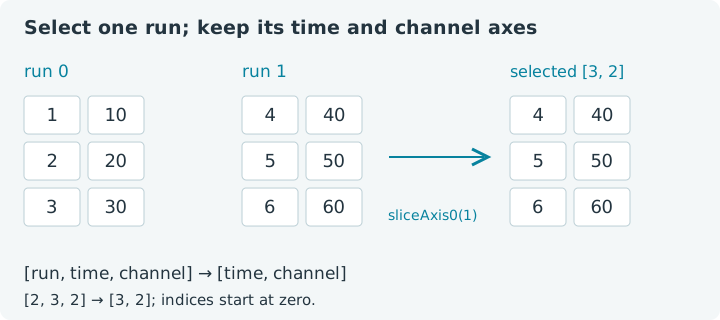
sliceAxis0(1) selects the second run. Indices begin at zero. Selecting one
position removes that leading axis, leaving shape [3, 2]: time and channel.
This method selects one leading-axis entry; it is not Python-style range-slice
syntax.
2. Select the second run
Expect the selected values [4, 40, 5, 50, 6, 60] and channel means [5, 50].
After slicing, axis zero refers to time. It no longer refers to run because
that axis was removed. A surprisingly common mistake is carrying old axis
numbers into a new shape without checking what remains.
Change the slice index to zero. The channel means become [2, 20]. Next, try
changing run.sum(0) to run.sum(1): you now get one sum per time step instead
of one sum per channel. Dividing those values by three would no longer compute
the desired channel means. An expression can execute successfully while its
interpretation has become wrong.
3. Reshape groups values; permute reorders axes
To combine runs and time into six rows, reshape(6, 2) is enough: the channel
pairs already occur in the right order. To put time before run, use
permute(1, 0, 2). Its arguments list the original axes in their new order.
The result has shape [3, 2, 2].
3. Flatten rows or reorder axes
The permuted flat sequence is [1, 10, 4, 40, 2, 20, 5, 50, 3, 30, 6, 60].
Each time step now groups both runs before moving to the next time. A plain
reshape(3, 2, 2) would keep the old flat sequence and assign different
meanings to neighboring values. Same dimensions, different data arrangement!
Try both operations and print their arrays side by side. Then use
permute(0, 2, 1) to arrange run, channel, time. Which three values should
appear first? They are the first channel's [1, 2, 3] within run zero.
The method requires each original axis exactly once; duplicate axes cannot
describe a permutation.
4. Reduce time and retain the channel distinction
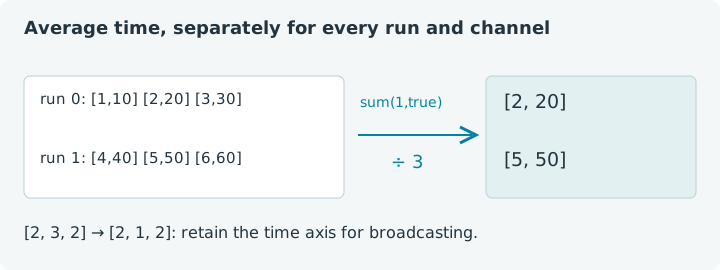
We can compute both runs' channel means directly. Reduce axis one, the time
axis of the original shape, and divide by three. Keeping the dimension gives
shape [2, 1, 2]. That singleton time axis lets the mean broadcast back across
the three time steps when we subtract it.
4. Center each run around its channel means
The means are [2, 20, 5, 50]. Each centered run becomes
[-1, -10, 0, 0, 1, 10]. Sum a centered run along time and each channel should
be zero for these exact integer inputs. You have combined a reduction with a
broadcast to normalize a structured batch, without a Java loop over runs.
Try changing true to false. The means then have shape [2, 2], which does
not broadcast to [2, 3, 2]: the aligned time dimensions disagree. The notebook
will show an exception. Restore true and rerun. Keeping a reduced axis is a
way to preserve alignment, not a way to retain its original data.
You can also reduce every element with mean(). Here that gives 19.25, but
it mixes channels with different scales and both runs together. It is a valid
arithmetic result and a poor substitute for the per-channel summary we asked
for. Decide which distinctions matter before reducing them away.
5. Maximum value or maximum location?
max(axis) returns values. argmax(axis) returns positions along that axis.
For our time sequences, each channel reaches its maximum at time index two.
The index refers to the selected axis, not to a position in the flattened
Java array.
5. Find each channel's peak time
Expect peak values [3, 30, 6, 60] and indices [2, 2, 2, 2], both arranged
as [run, channel]. In this version, argmax indices are represented as F32
values, so the Java printout includes decimal points. Small integer indices
are exact in F32; the result is not an integer-typed tensor just because it
represents positions.
Change run zero's first pair to [8, 80] and rerun setup and this cell. Its
first two peak indices should move to zero; the last two, belonging to the
unchanged second run, remain two. Print the peak values alongside the indices
and check both. Axis labels make a better guide than the flat printout.
6. Keep selection mistakes recoverable
There are only two runs, so valid leading-axis indices are zero and one. The next cell catches an out-of-range selection. Because the failure is contained, Run all still completes and you can immediately try a valid index.
6. Catch an out-of-range run
Change the index to one and the cell prints [3, 2]. If you want to select
another axis, first decide whether reordering axes is appropriate; do not
assume that the index argument also specifies which axis to slice. The current
notebook examples deliberately use this narrow API so the shape change stays
explicit.
For a final experiment, keep only run zero, reshape its values into a vector
of length six, and compare its overall mean 11.0 with its two channel means
[2, 20]. Both answers are correct for their respective questions. Now explain
which operations changed order, which changed grouping, and which discarded
information. If you can follow those changes, a twelve-number tensor has done
its teaching job.
Continue with matrix multiplication and linear algebra to combine feature values through weighted sums. For alignment practice, return to broadcasting and give the runs a shared calibration vector before reducing time.