Mapped inputs, shared inputs and output axes
Choose which arguments vary per example, share parameter tensors and put the mapped output axis where you need it.
Run cells from top to bottom. Typed declarations and imports carry into later cells. Shift + Enter runs a cell. Reloading or leaving this page discards edits and Java state.
One vector for every row, or one offset per row?
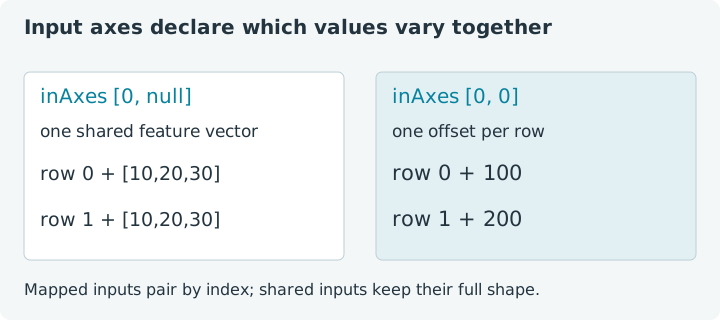
Our batch has rows [1, 2, 3] and [4, 5, 6]. Adding a shared vector
[10, 20, 30] gives [11, 22, 33] and [14, 25, 36]. Adding a separate
scalar offset to each row, 100 then 200, gives [101, 102, 103] and
[204, 205, 206]. Both operations are additions; the mapping specification
says which values travel together.
The multi-input Vmap.apply accepts a function over a list of tensor arguments,
an axis specification for each input, and one output axis. An integer input
axis selects the dimension to map. A null input axis means the whole tensor
is shared with every logical example.
Choose Run all, then alter axes and values in the individual cells. This notebook uses jax4j 0.2.1 on the emulated CPU. Each cell creates and closes its own ordinary tensor inputs and new outputs. Imports and the explicitly typed Java data array persist. Leaving or reloading discards state and edits.
1. Share a feature-wise vector
The batch is mapped on axis zero, while the bias vector is shared. Inside
the logical function, the row and the shared bias both have shape [3].
Their addition is ordinary elementwise arithmetic.
Use Arrays.asList(0, null) for the input-axis list. Java's List.of rejects
null entries before vmap even sees them; this small collection detail matters
when spelling “shared” in Java.
1. Add a shared vector to every row
Expect shape [2, 3] and flat values [11, 22, 33, 14, 25, 36].
Try this: change only the last bias value from 30 to 0. The third
entry of both output rows changes. You are modifying one feature's shared
parameter, so both observations should respond.
A shared input remains a tensor argument. It can carry new values on the next call; it is not a Java scalar frozen during JIT capture. If this mapped function is later compiled as a multi-leaf tree, the shared tensor is still an explicit runtime leaf in that outer function.
2. Map two arguments together
Now the second argument is a vector of two row offsets. Mapping its axis zero produces one scalar slice per example. That scalar broadcasts across the three entries of the corresponding logical row. Mapped axes must have the same length, but their remaining sample shapes can differ.
2. Pair each row with its offset
Expect [101, 102, 103, 204, 205, 206]. Change only the second offset to
-100; only the second row changes. This is a different dependency pattern
from the shared feature bias. Predicting which positions move is a useful
check before worrying about the exact numbers.
The two mapped inputs are paired by index. This call combines row zero with offset zero and row one with offset one; it does not form every possible row-offset pair. To request a Cartesian product, you would need another mapping level or another explicit arrangement of axes.
3. Move the mapped output axis
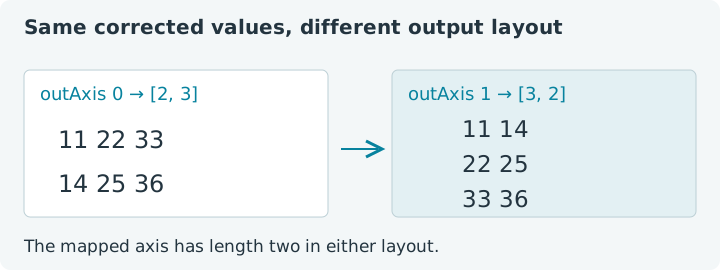
The output-axis argument chooses where the mapping dimension appears in the
returned tensor. The per-example addition still returns a vector of shape
[3]. Putting the mapped dimension at output axis one produces shape [3, 2],
with the two observations side by side for each feature.
3. Put observations on the last output axis
Expect [3, 2] and [11, 14, 22, 25, 33, 36]. The output entries are
rearranged; their numerical meaning has not changed. Compare this with the
first cell's row-major output and draw the two matrices before experimenting
with another axis value.
4. Map an input axis other than zero
We can map the original batch's axis one instead. There are now three logical
examples, each containing two entries: the columns [1, 4], [2, 5],
[3, 6]. A shared vector [10, 100] aligns with those two-entry examples.
Putting the output mapped axis back at one preserves the original matrix layout.
4. Map columns and restore their position
Expect [2, 3] and [11, 12, 13, 104, 105, 106]. Try output axis zero
instead. The result becomes [3, 2], with flat values
[11, 104, 12, 105, 13, 106]. The logical examples are still columns;
only their placement in the returned tensor changes.
Negative axes count from the end. Here input axis -1 means axis one of a
rank-two batch, and output axis -1 also means axis one of its rank-two
result. Try replacing both ones with -1. Normalize axes against the actual
input or output rank, rather than treating a negative index as a special
batching mode.
5. Return a mapped result and an unmapped summary
Vmap.applyTree supports structured outputs with one output-axis entry per
leaf. Our function returns the corrected rows and the sum of the shared bias.
That bias sum does not depend on a mapped input, so its output axis can be
null. It is returned once, with shape [1], instead of being repeated per row.
5. Keep a shared summary outside the batch axis
Expect corrected shape [2, 3] and summary shape [1] with value 60.
The summary is the sum of the bias, not the total of all corrected readings.
Try replacing the second expression with a.get(1).mul(a.get(1)).sum();
the shared summary becomes 1400.
A null output axis requires an unmapped result. It cannot remove a genuine
mapped dimension by declaration. Giving the corrected rows a null output axis
would be rejected; reduce the mapped result explicitly afterward if you need
a total across examples. Axis lists follow deterministic tree-leaf order,
which matters when replacing this simple output list with records or maps.
6. Catch unequal mapped lengths
The following offsets have length three, while the batch's mapped row axis has length two. Because both inputs are marked mapped on axis zero, their lengths disagree before the body can combine them. Catching that error keeps Run all useful while showing the exact boundary being checked.
6. Catch a mapped-size mismatch
Keep the first input mapped and replace List.of(0, 0) with
Arrays.asList(0, null).
The three offsets become a shared feature vector, producing rows
[101, 202, 303] and [104, 205, 306]. This fixes the shape mismatch by
asking another question. Check that the new dependency pattern is actually
what you intended.
Continue with explicit random keys before adding randomness to a mapped function. Revisit parameter trees when organizing several mapped and shared tensors into a readable input schema.