The binomial lattice, from scratch
The one valuation a record-and-replay Monte-Carlo tape genuinely cannot do, why NablaTensor answers it with a completely separate plain-double engine, and what that engine gives up by not being on the tape.
Every payoff so far has been one fixed sequence of arithmetic, recorded once and replayed for as many random paths as you like. What happens when a contract needs to decide, at every single step, whether exercising right now beats waiting — a decision whose answer can change from one market state to the next?
The whole story
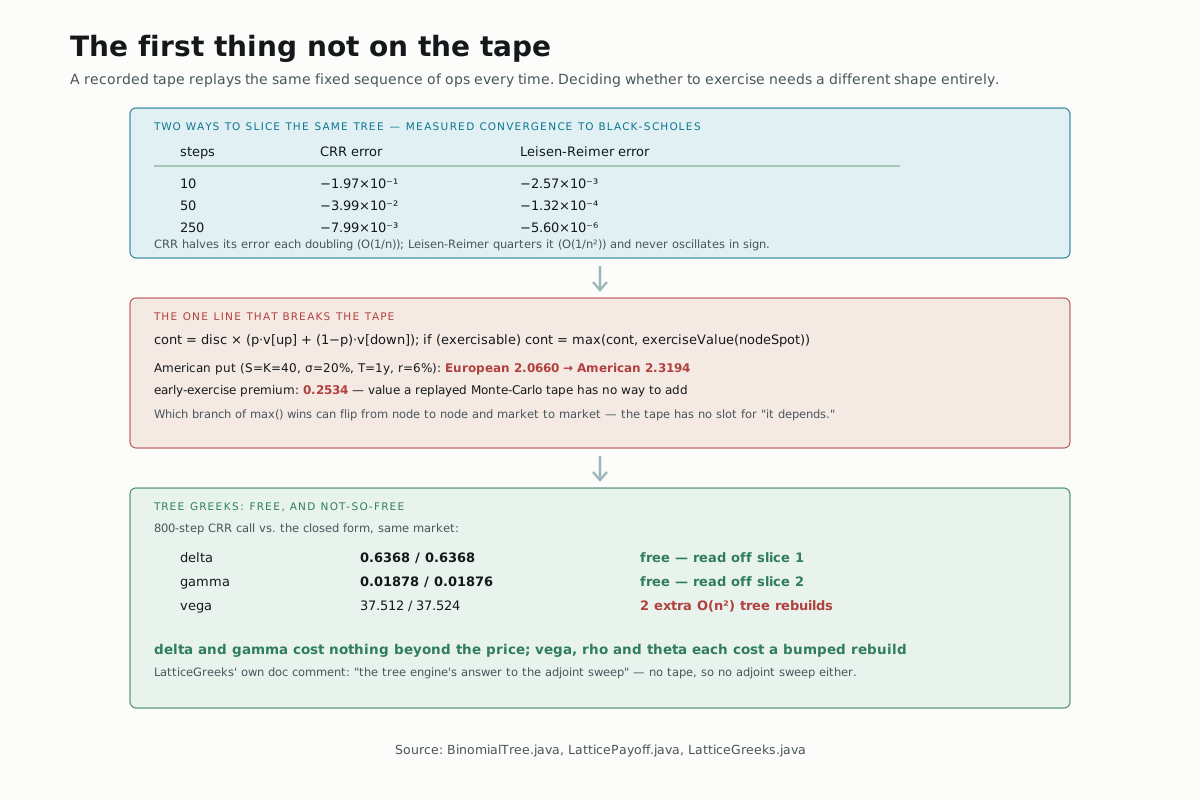
BinomialTree's own doc comment says it plainly: "deliberately not on the
adjoint tape... a plain double, O(n²) companion." Every earlier
module recorded a fixed sequence of ADouble operations once and replayed
it under different markets. Backward induction can't do that — at every
node it computes max(continuation, exercise), and which branch wins
depends on the very values the tape would need to have already computed
to know what to record. A recorded tape assumes the same operations run
every time; this algorithm's shape depends on its own numbers.
Two ways to slice the same tree
BinomialTree.Method.CRR (Cox-Ross-Rubinstein) is the textbook
parameterization — up-factor u = e^{σ√dt}, down-factor 1/u:
case CRR -> {
  double u = Math.exp(vol * Math.sqrt(dt));
  return new Lattice(u, 1.0 / u, (growth - 1.0 / u) / (u - 1.0 / u), disc);
}
Method.LEISEN_REIMER inverts Black-Scholes' own d1/d2 through a
Peizer-Pratt approximation instead, at the cost of needing an odd step
count (BinomialTree's constructor bumps an even one up by one). Pricing
the same European call (GeneralizedBsm's closed form: 10.450584) at
six step counts with both:
| steps | CRR error | Leisen-Reimer error |
|---|---|---|
| 10 | −1.97×10⁻¹ | −2.57×10⁻³ |
| 50 | −3.99×10⁻² | −1.32×10⁻⁴ |
| 250 | −7.99×10⁻³ | −5.60×10⁻⁶ |
| 500 | −4.00×10⁻³ | −1.41×10⁻⁶ |
CRR's error roughly halves every doubling of steps (O(1/n)) and
oscillates in sign along the way (+7.04×10⁻² at 25 steps, sandwiched
between two negative rows) — the textbook even/odd wobble. Leisen-Reimer's
error roughly quarters every doubling (O(1/n²)) and never changes sign:
faster convergence, bought by that odd-step-count, vanilla-only
restriction.
Backward induction, and the line that breaks the tape
induct() walks backward from the terminal payoff, and every intermediate
node runs the same two lines:
double cont = l.disc() * (l.p() * v[j + 1] + (1.0 - l.p()) * v[j]);
if (exercisable) {
  cont = Math.max(cont, early.exerciseValue(nodeSpot(l, i, j)));
}
next[j] = cont;
That Math.max is plain-double arithmetic, not ADouble.max — there's
no tape here to record onto. Pricing an American put (S=K=40, σ=20%,
T=1y, r=6%) against its European twin, both on the same 2,000-step
CRR tree:
| schedule | price |
|---|---|
| European | 2.0660 |
| American | 2.3194 |
The 0.2534 gap is the early-exercise premium — value that comes purely
from the option to exercise early, which a replayed Monte-Carlo tape has
no mechanism to add, because nothing about "stop here if it's better" is a
fixed sequence of arithmetic. Whether it's worth anything at all depends
on the contract: a no-dividend American call on this same tree prices
exactly equal to its European twin (10.446585 both ways, to six
decimals) — the textbook result that early exercise is never optimal
without a dividend to capture — while adding a 4% dividend yield makes the
American call worth 0.0156 more. A Bermudan schedule (exercisable every
50 of those 2,000 steps) prices the put at 2.3126: strictly between the
European and American bookends, exactly where you'd expect a "sometimes"
to sit between a "never" and an "always."
LatticeGreeks' own doc comment calls itself "the tree engine's answer to
the adjoint sweep." Delta and gamma are read straight off the tree's own
first two backward-induction slices — nodes the algorithm was already
computing on the way to the price, so they cost nothing extra. Vega, rho,
and theta get no such shortcut: each one rebuilds the entire O(n²)
tree with one parameter bumped up and down, exactly the bump-and-revalue
technique 2.1 built a whole page around adjoint AD making unnecessary —
alive and well here, because there's no tape to differentiate instead.
Tree Greeks: free, and not-so-free
An 800-step CRR call against the closed form, same market:
| Greek | tree | closed form | cost |
|---|---|---|---|
| delta | 0.6368 | 0.6368 | free — slice 1 |
| gamma | 0.01878 | 0.01876 | free — slice 2 |
| vega | 37.512 | 37.524 | 2 extra tree rebuilds |
Delta and gamma agree with Black-Scholes to four decimals for free; vega is close but visibly noisier, the way a finite-difference estimate always is next to an adjoint one.
Try it yourself
Leisen-Reimer's error roughly quarters every time the step count doubles.
Using the 250 → 500 step in the table above (−5.60×10⁻⁶ → −1.41×10⁻⁶,
a 4× drop), predict the error at 1,000 steps before running it — you
should land somewhere near −3.5×10⁻⁷.
▶️ Run it
mvn -o -q -pl nablatensor-examples exec:java \
  -Dexec.mainClass=com.nablatensor.examples.LatticeConvergenceShowcase
Pure CPU, O(n²) double arithmetic — no engine string to pick, because
there's no tape to compile a kernel from.
⚠️ What this doesn't do
Leisen-Reimer only prices vanillas (priceVanilla, not the general
price(payoff, schedule) a Bermudan or custom payoff needs) — CRR or
Jarrow-Rudd are the only choices once the payoff or schedule gets more
interesting than a plain call or put. This page also doesn't derive
Bermudan pricing beyond the one number above, or explain how a Monte-Carlo
engine that can't look ahead the way a tree does still manages to price
early exercise at all — Longstaff-Schwartz regression, and exactly how
honest a gap NablaTensor's current implementation of it is, is next.
What's next
→ Deeper: Binomial trees: convergence, early exercise, and tree Greeks
has Jarrow-Rudd, the ConvergenceTable Richardson extrapolation this page
skipped, and the full pinned-test tolerances.
→ Next: Bermudan options and the honest gap —
where a Monte-Carlo tape gets its own, much more approximate, answer to
the same early-exercise question.