Writing a custom op
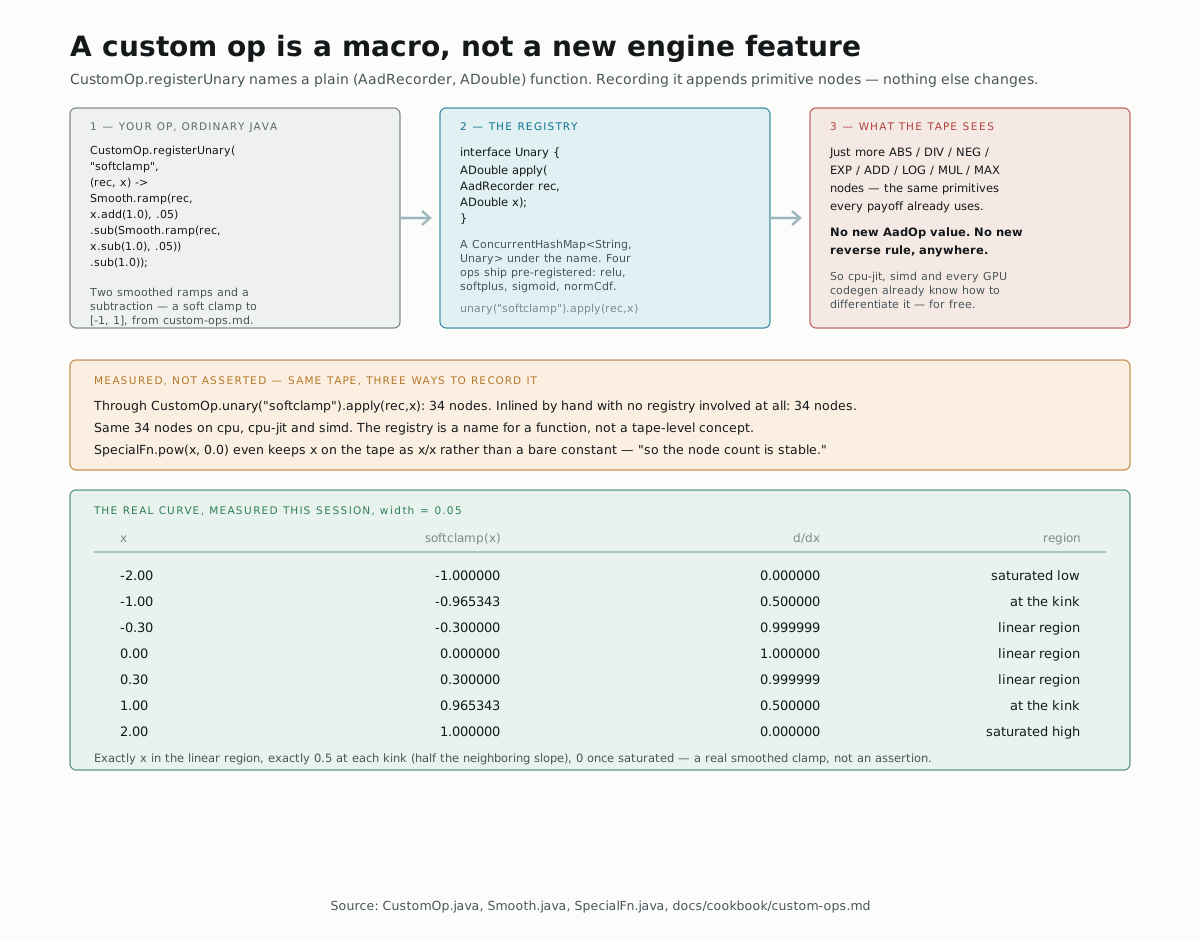
The engine's whole primitive vocabulary is +, -, *, /, exp, log, sqrt, abs, max, min and randn. CustomOp lets you name a new differentiable building block anyway — a plain Java function that expands into those same primitives when recorded, with no new AadOp, no new reverse rule, and no engine change at all. Measured this session: the exact same 34-node tape whether you go through the registry or inline the expression by hand, identical on cpu, cpu-jit and simd.
Every payoff in this Learn section has been built from the same dozen
primitives: + - * / exp log sqrt abs max min randn, plus constants. What
do you do the day you want a genuinely new building block — a smoothed
clamp, a house payoff kink nobody's written yet — without touching the
engine at all?
The whole story
Smooth.ramp's softplus isn't the textbook width * log(1 + exp(x / width)) — that formula overflows the moment x / width gets past a few
hundred. The real source computes max(x, 0) + width * log(1 + exp(-|x| / width)) instead: algebraically identical (work through both cases,
x >= 0 and x < 0, and they match term for term), but the argument to
exp is never positive, so it can't overflow no matter how large x
gets relative to width. The rewrite buys correctness at the numeric
extremes for free — nobody has to remember to clamp anything.
The registry is two maps and an interface
Real source, CustomOp.java, in full for the unary half:
@FunctionalInterface
public interface Unary {
  ADouble apply(AadRecorder rec, ADouble x);
}

private static final Map<String, Unary> UNARY = new ConcurrentHashMap<>();

public static void registerUnary(String name, Unary op) {
  UNARY.put(requireName(name), Objects.requireNonNull(op, "op"));
}

public static Unary unary(String name) {
  Unary op = UNARY.get(name);
  if (op == null) {
    throw new IllegalArgumentException("no unary custom op named '" + name + "'; registered: " + UNARY.keySet());
  }
  return op;
}
That's the entire mechanism. registerUnary puts a function in a map;
unary(name).apply(rec, x) looks it up and calls it. There's no builder,
no annotation processor, no code generation step — a custom op is a name
for a lambda, nothing more.
A custom op, end to end
The engine's own cookbook (docs/cookbook/custom-ops.md) registers a soft
clamp to [-1, 1] from two calls to Smooth.ramp (Chapter 12.1's rolled
kernel used the same Smooth/SpecialFn classes' arithmetic, one chapter
earlier — this is what actually sits inside a tape node):
CustomOp.registerUnary("softclamp", (rec, x) ->
    Smooth.ramp(rec, x.add(1.0), 0.05).sub(Smooth.ramp(rec, x.sub(1.0), 0.05)).sub(1.0));

ADouble y = CustomOp.unary("softclamp").apply(rec, someScalar);
Real numbers, this session, one scenario per x, adjoint from the same
reverse sweep every other page in this Learn section has used:
| x | softclamp(x) | d/dx | region |
|---|---|---|---|
| -2.00 | -1.000000 | 0.000000 | saturated low |
| -1.00 | -0.965343 | 0.500000 | at the kink |
| -0.30 | -0.300000 | 0.999999 | linear |
| 0.00 | 0.000000 | 1.000000 | linear |
| 1.00 | 0.965343 | 0.500000 | at the kink |
| 2.00 | 1.000000 | 0.000000 | saturated high |
It's exactly x through the linear region, exactly half the neighboring
slope at each kink — the two ramps' transitions overlapping — and flat
once saturated. Not a plausible shape; the printed table above is System .out from a real run.
It's a macro, not a special op
CustomOp.unary(name).apply(rec, x) is a plain Java method call at record
time — it runs the registered lambda once, right there, and whatever
primitive nodes that lambda appends are the only trace it leaves. Measured
this session, same tape, three ways to build it:
via CustomOp.unary("softclamp"):  nodes=34   (cpu, cpu-jit, simd — all three)
inlined by hand, no registry:     nodes=34
Identical. AadTape has no CUSTOM_OP opcode and never will need one for
anything expressible this way — a custom op and the same expression typed
out by hand are, to the tape, the same tape. Which is also why it needs
nothing from any code generator: cpu-jit's KernelGenerator (Chapter
12.1), simd's vectoriser, and every GPU backend's codegen were already
able to differentiate ABS/DIV/EXP/LOG/MUL/MAX before your op
existed. Naming a composition of them doesn't ask any of those generators
to learn anything new.
Four ops already registered
static {
  registerUnary("relu", (rec, x) -> x.max(0.0));
  registerUnary("softplus", (rec, x) -> Smooth.ramp(rec, x, 0.05));
  registerUnary("sigmoid", (rec, x) -> Smooth.step(rec, x, 1.0));
  registerUnary("normCdf", SpecialFn::normCdf);
}
Worth noticing which one doesn't belong with the other three: relu is
the literal, discontinuous max(x, 0) — the same kinked MAX node Chapter
3.2 met on a barrier payoff, not a smoothed stand-in. softplus,
sigmoid and normCdf are all genuinely mollified. If your own custom op
needs a clean adjoint through the kink, reach for Smooth.ramp the way
softplus does, not relu's bare max.
SpecialFn.pow(x, 0.0) doesn't return a bare constant 1.0 for x^0 —
it returns x.div(x), and the source comment says exactly why: "1, but
keeps x on the tape so the node count is stable." A quant reading the
generated tape and spotting a redundant x / x = 1 node might assume it's
a bug the optimizer missed. It isn't — it's deliberate, so that swapping
p between exponents never changes how many nodes a payoff records.
Try it yourself
Change the width in the cookbook's softclamp registration from 0.05 to
0.5 — one number — and rerun. Real numbers, this session: softclamp(1 .0) moves from 0.965343 (barely below the saturated value) to
0.662501, and the derivative at that same kink moves from 0.500000 to
0.482014. A wider smoothing width blurs the clamp's corner further out
on both sides — the same width-versus-sharpness trade-off Chapter 3.2's
barrier smoothing made, one parameter, immediately visible.
▶️ Run it
The registry, the softclamp registration, and the sweep above — live,
available here. CustomOp and Smooth run completely unmodified; this is
the one lesson in this whole Learn section whose engine-side code needed
no rewrite at all, since there's no reflection anywhere in CustomOp's
own mechanism to route around. The one substitution is recording through
rec.input() directly instead of the standalone snippet's Nabla.model (new P(x), ...), which still goes through a one-field record's reflective
component lookup — kept only for consistency with every earlier chapter's
cell, not because this page's own code needs it:
There's no dedicated nablatensor-examples class for a custom op yet — the
table above came from a small standalone program built against the
engine's own jars, following exactly the pattern OpsTest.java
(nablatensor-ops/src/test/java/.../OpsTest.java) uses for its own
value-and-adjoint checks:
CustomOp.registerUnary("softclamp", (rec, x) ->
    Smooth.ramp(rec, x.add(1.0), 0.05).sub(Smooth.ramp(rec, x.sub(1.0), 0.05)).sub(1.0));

try (Nabla.TypedPricer<P> pricer = Nabla.model(new P(x), (rec, in) ->
    rec.output(CustomOp.unary("softclamp").apply(rec, in.of(P::x))))
    .fp64().greeks().on("cpu-jit").build()) {
  var v = pricer.value().with(new P(x)).scenarios(1).seed(1L).run();
  System.out.println(v.price() + "  " + v.greek(P::x) + "  nodes=" + pricer.nodes());
}
(P is any one-field record, e.g. record P(double x) {}.) Swap "cpu-jit"
for "cpu" or "simd" and the printed value, derivative and node count
don't move — that agreement is OpsTest's own
customOpRunsIdenticallyOnEveryCpuBackend test, run by hand instead of
through Maven.
⚠️ What this doesn't do
OpsTest also has a customOpRunsOnAGpuBackendWithNoEngineEdit test —
the Phase-1 definition-of-done the cookbook's "Verification" section
describes — but it calls AadEngines.available(...) to find a GPU
backend, the exact auto-probe this Learn section has avoided running
directly since Chapter 4.1 (see the sandbox-is-real-desktop caution
carried since then). Nothing here disputes that the GPU leg passes; it
just wasn't re-run on this machine, same precedent as every GPU number in
Chapters 4 and this one. This page also stops at the composable "macro"
form (Seam 3): a fused op — one that isn't expressible as a
composition of existing primitives at all, with a hand-written forward and
adjoint rule registered directly into every code generator — is, per
CustomOp's own class doc, "a later engine feature," not something this
version of the engine can do yet.
What's next
→ Deeper: docs/cookbook/custom-ops.md
has the full building-blocks table (Smooth.gt/between, SpecialFn.erf/
pow) this page didn't need for one example.
→ Next: Anatomy of a GPU kernel source file
— a different GPU-facing subsystem, the tensor library's own hand-written
CUDA-C catalog.