finmath-lib, Strata, JQuantLib vs. NablaTensor
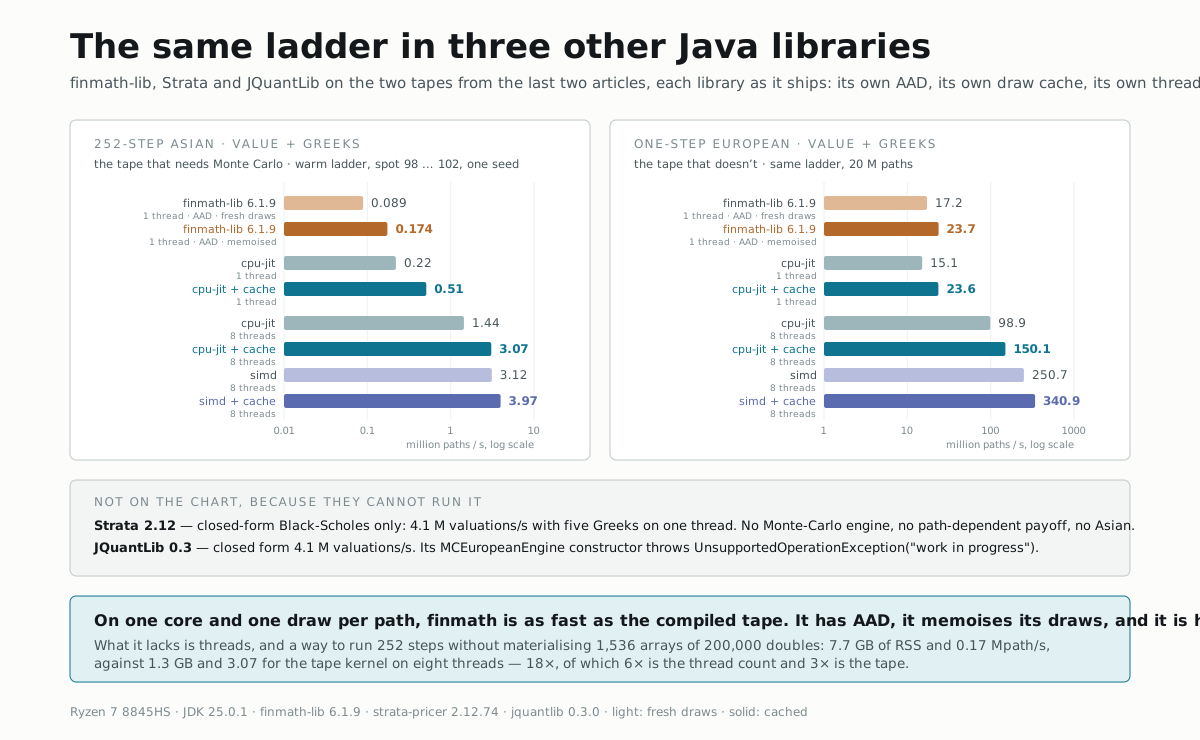
The two Monte-Carlo tapes and the spot ladder from the last two articles, run on the three Java quant libraries closest to NablaTensor — each as it ships, with every speedup it offers: finmath's backward AAD and memoised Brownian increments, Strata's closed forms, JQuantLib's analytic engine. finmath ties the compiled tape per core on the one-step European and loses 18x on the 252-step Asian, 6x of it threads and 3x of it the tape. Two of the three cannot run the Asian at all.
The last two articles measured one thing against itself. The compiled tape against the tape interpreter; the draw cache against no draw cache. Useful, and also the easiest kind of benchmark to win, because the author controls both sides.
So this one puts the same two tapes and the same seven-point spot ladder in front of the three Java libraries a quant would reach for instead of NablaTensor, and runs each of them the way its own documentation says to.
- finmath-lib 6.1.9 — Christian Fries' library, the standard Java mathematical-finance stack for Monte Carlo, LIBOR market models and xVA. It has backward-mode automatic differentiation built in — a separate extension module until it was folded into the core library at version 3.3 — so it gets to use it.
- Strata 2.12.74 — OpenGamma's Apache-2.0 market-risk library, used in production at banks for curves, pricing and sensitivities.
- JQuantLib — the Java port of QuantLib, in the 0.3.0 repackaging that is on Maven Central.
The rules, stated before the numbers so that they cannot be adjusted after:
- Every library runs as it ships. If it offers adjoint Greeks, it uses them. If it memoises random draws, that is used too. If it exposes a thread count, it gets eight threads like the NablaTensor engines. If it does not, it runs on one, and the table says so — I did not wrap anything in an executor to manufacture an eight-thread number. What a library can do is the measurement; what I could build on top of it is not.
- Same product, same market, same schedule:
S = K = 100,σ = 20%,r = 3%,T = 1, the one-step European call and the 252-fixing arithmetic Asian call, log-Euler on a uniform grid. - Same ladder: spots 98, 99, 99.5, 100, 100.5, 101, 102, one seed, warm-up
on a different seed, three ladders, median of the six warm calls. The
NablaTensor rows are the ones already published in the draw-cache article,
plus a one-thread
cpu-jitrow measured for this piece so that there is a per-core comparison in both directions.
Everything below was measured on referential machine — Ryzen 7 8845HS, Zulu OpenJDK 25.0.1 — with the three libraries pulled from Maven Central at the versions above.
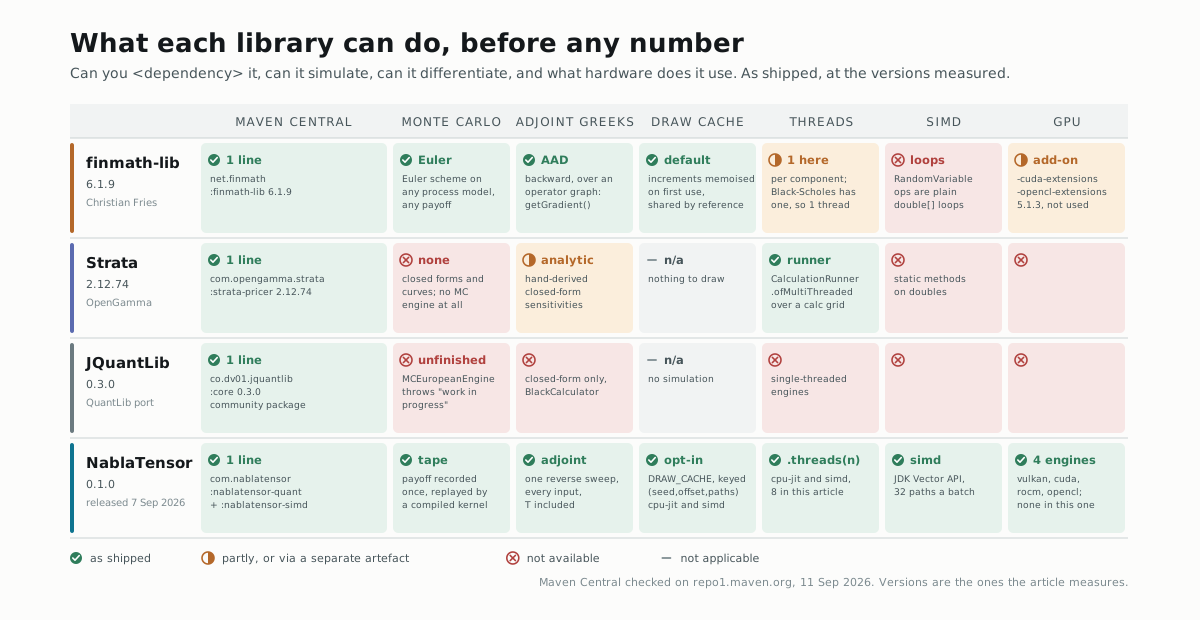
What each library turned out to be able to do
This section was supposed to be one paragraph. It is the most important section in the article.
finmath-lib can do all of it. BlackScholesModel plus
EulerSchemeFromProcessModel plus a payoff written against its RandomVariable
type is the Asian in nine lines. Wrap the model's inputs in
RandomVariableDifferentiableAADFactory and the same nine lines produce delta,
strike sensitivity, vega and rho from one getGradient() call — a real
backward sweep over an operator graph, the same idea as NablaTensor's tape.
And BrownianMotionFromMersenneRandomNumbers generates its increments lazily
and keeps them, so two models built on the same BrownianMotion object share
draws: finmath has had a draw cache since before NablaTensor existed, and it is
on by default.
What finmath does not have, on this workload, is a second core.
EulerSchemeFromProcessModel does have multithreading — a system property,
isUseMultiThreadding, on by default — but it parallelises across model
components, and a Black-Scholes model has one. The arithmetic on a
RandomVariableFromDoubleArray is a plain sequential loop. Measured with the
serial collector so that GC threads could not confuse the reading: 8.25 s of
user time in 9.91 s of wall clock. One thread, as shipped. (An eight-way path
shard is about forty lines of your own code and works fine; I wrote it, it is
not in the tables, because it is my code and not the library's.)
Strata has no Monte-Carlo engine. None. It is a market-risk library built
on closed forms, curves and calibration, and its equity-option content is
BlackScholesFormulaRepository: price, delta, dual delta, gamma, vega, rho,
theta and a dozen higher-order Greeks, each a static method on six doubles
and a call/put flag.
For the European that is the right tool and it appears below. For the Asian
there is nothing to call.
JQuantLib has an MCEuropeanEngine class, and I was looking forward to it.
Its constructor, in the 0.3.0 jar:
public MCEuropeanEngine();
  Code:
     4: new           #2   // class java/lang/UnsupportedOperationException
     8: ldc           #3   // String work in progress
    13: athrow
MCVanillaEngine has an empty constructor and nothing else; the Asian engines
present are the two closed-form geometric-average ones. The Monte-Carlo half of
the QuantLib port was never finished. AnalyticEuropeanEngine does work, and
returns QuantLib's full Greek set from one BlackCalculator pass, so JQuantLib
also appears in the European table — as a closed form.
So the honest shape of the comparison is: on the European, five contenders, two of them not simulating anything; on the Asian, the one that actually needs Monte Carlo, one library besides NablaTensor can run it at all.
The same thing as a figure, with the two questions a reader asks before any
benchmark — can I <dependency> it, and what hardware does it use — added:
finmath's random numbers have a period of 2¹⁹⁹³⁷ − 1, and that is why they are
called what they are called. BrownianMotionFromMersenneRandomNumbers draws
from the Mersenne Twister, MT19937, published by Makoto Matsumoto and Takuji
Nishimura in 1998. Its period is 2¹⁹⁹³⁷ − 1, which is a Mersenne prime — a
prime of the form 2ᵖ − 1 — and the "twister" is the linear transformation on
its 624-word state that makes the recurrence cheap. It is the default generator
in Python, R, Ruby, PHP, MATLAB, Julia until 1.7, and most of the simulation
code written this century.
It is also exactly the kind of generator that a counter-based design like Philox exists to replace: it has 2.5 KB of state and a place it is up to, so path p can only be generated after paths 0 through p − 1, on the thread that generated them. That is why finmath's Brownian increments have to be produced once, sequentially, and stored — which is the same reason its draw cache is on by default. A stateless generator can afford to regenerate; a stateful one cannot afford not to remember.
The one-step European
Twenty million paths, fp64. finmath is measured once per configuration on one
thread; the NablaTensor rows are from the draw-cache article, plus the
one-thread cpu-jit rows measured for this one.
| library | threads | Greeks | draws | price only | value + Greeks | peak RSS, price / Greeks |
|---|---|---|---|---|---|---|
| finmath-lib 6.1.9 | 1 | AAD, 4 | fresh BrownianMotion per call | 33.7 Mpath/s | 17.2 | 11.1 / 16.8 GB |
| finmath-lib 6.1.9 | 1 | AAD, 4 | one BrownianMotion, memoised | 68.3 | 23.7 | 10.1 / 16.5 GB |
cpu-jit | 1 | adjoint, 5 | regenerated | 23.8 | 15.1 | 67 / 70 MB |
cpu-jit + DRAW_CACHE | 1 | adjoint, 5 | cached | 40.5 | 23.6 | 351 / 281 MB |
cpu-jit | 8 | adjoint, 5 | regenerated | 155.6 | 98.9 | 68 / 72 MB |
cpu-jit + DRAW_CACHE | 8 | adjoint, 5 | cached | 285.4 | 150.1 | 369 / 375 MB |
simd | 8 | adjoint, 5 | regenerated | 340.9 | 250.7 | 127 / 553 MB |
simd + DRAW_CACHE | 8 | adjoint, 5 | cached | 632.1 | 340.9 | 428 MB / 1.2 GB |
The last column is the peak resident set of the whole process — every thread,
the JVM, and the draw cache — for the price-only run and for the Greeks run,
read with GNU time from a separate one-ladder run of each configuration. The
NablaTensor rows ran with the default heap; the finmath rows with the -Xmx16g
the Asian below needs, and finmath fills whatever heap it is given: every
RandomVariable operation allocates a fresh 160 MB double[20,000,000], and
G1 lets them pile up until the ceiling. The same European ladder completes in a
1 GB heap on the price pass and a 4 GB heap on the Greeks pass, so read the
finmath cells as "what it takes when it can", not as a floor. (A spot check
worth its own article: with -Xmx1g the price-only pass ran 2.8× faster
than with -Xmx16g on this box, because the collector reuses the same few
regions instead of touching fresh pages for every array. The 68.3 above was
measured with a 14 GB heap.)
And the two closed forms, which do not simulate and are listed in their own unit because a "path" is not a thing they have:
| library | threads | what a valuation is | valuations / s | peak RSS |
|---|---|---|---|---|
Strata 2.12.74 BlackScholesFormulaRepository | 1 | price + delta, dual delta, vega, rho, theta (six static calls) | 4.10 M | 60 MB |
JQuantLib 0.3.0 AnalyticEuropeanEngine | 1 | NPV() + delta, vega, rho, theta from one BlackCalculator | 4.08 M | 527 MB |
Three things to take from this, and the first is the one I did not expect.
On one core, finmath is as fast as the compiled tape, and on the price pass it is faster. 33.7 against 23.8 million paths per second with fresh draws; 68.3 against 40.5 with cached ones. On the Greeks pass, memoised draws on both sides, it is a dead heat: 23.7 against 23.6. NablaTensor's whole first article was about the cost of interpreting a tape per path, and here is a library that does not compile anything, does not generate bytecode, and matches it.
The reason is that finmath does not interpret per path either. Its
RandomVariable is an array of paths, and every operation — mult, exp,
sub, floor — is one tight loop over twenty million doubles. That is the
NumPy design: dispatch once per operation, not once per operation per path, so
the dispatch cost that cpu-jit had to compile away is amortised over the
whole array instead. On a one-step tape with a dozen operations, each of them a
streaming pass over 160 MB, it is a perfectly good way to run a Monte Carlo.
The draw generation is also cheaper: Mersenne Twister plus an inverse normal
CDF, against Philox's ten rounds and Box-Muller's log, sqrt and sincos.
The memoised draws are worth the same thing in both libraries. finmath's
price pass goes 2.0× faster on cached increments, its Greeks pass 1.4×; the
draw-cache article measured 1.8× and 1.5× for cpu-jit. That is not a
coincidence, it is Amdahl on the same RNG share, and it is a quiet confirmation
that the two libraries are doing comparable amounts of work per path once the
random numbers are out of the way.
The 6.3× between them at the end of the table is the thread count and
nothing else. cpu-jit on eight threads with the cache does 150.1 on the
Greeks pass; finmath, at parity per core, does 23.7. Every bit of that gap is
cores finmath cannot use, and every bit of simd's further 2.3× is the Vector
API. On this tape the compiled kernel wins by being parallel, not by being
compiled.
And the closed forms: 4.1 million complete valuations per second, price and five Greeks, on one thread. That is 240 nanoseconds each. Twenty million Monte-Carlo paths at 632 million per second take 32 milliseconds to reach a price with a standard error of 0.003; Strata reaches the exact answer in a quarter of a microsecond. Nobody prices a vanilla European by simulation, and the row is here to say so in numbers. The Monte-Carlo rows exist because of the next table.
The 252-step Asian
The tape that needs simulation: 1,536 nodes, 252 draws per path, an arithmetic
average that no closed form covers. Strata has nothing to call. JQuantLib's
engine throws. finmath runs it — at 200,000 paths rather than the 300,000 of
the NablaTensor rows, because its AAD operator graph keeps a double[paths]
per node and 300,000 paths did not fit in a 16 GB heap. Throughput is per path
and does not depend on the count at this size, but the difference is stated.
| library | threads | Greeks | draws | price only | value + Greeks | peak RSS, price / Greeks |
|---|---|---|---|---|---|---|
| finmath-lib 6.1.9 | 1 | AAD, 4 | fresh BrownianMotion per call | 0.125 Mpath/s | 0.089 | 4.7 / 7.2 GB |
| finmath-lib 6.1.9 | 1 | AAD, 4 | one BrownianMotion, memoised | 0.338 | 0.174 | 4.8 / 7.7 GB |
cpu-jit | 1 | adjoint, 5 | regenerated | 0.26 | 0.22 | 76 / 112 MB |
cpu-jit + DRAW_CACHE | 1 | adjoint, 5 | cached | 0.84 | 0.51 | 995 / 829 MB |
cpu-jit | 8 | adjoint, 5 | regenerated | 1.69 | 1.44 | 80 / 119 MB |
cpu-jit + DRAW_CACHE | 8 | adjoint, 5 | cached | 4.62 | 3.07 | 1.2 / 1.3 GB |
simd | 8 | adjoint, 5 | regenerated | 4.29 | 3.12 | 191 / 419 MB |
simd + DRAW_CACHE | 8 | adjoint, 5 | cached | 7.69 | 3.97 | 1.4 / 1.4 GB |
| Strata 2.12.74 | — | — | — | no Monte-Carlo engine | ||
| JQuantLib 0.3.0 | — | — | — | MCEuropeanEngine: "work in progress" |
Same memory column as above, whole process, price run / Greeks run. The NablaTensor rows are at 300,000 paths, so their draw cache is 300,000 × 252 doubles, 605 MB, and that is what separates the cached rows from the uncached ones. The finmath Greeks pass at 200,000 paths is 7.7 GB and does not fit at 300,000 paths with a 16 GB heap; that is not the heap filling up for lack of collection, it is the operator graph, as the next section says.
Read the two bold columns. On the Greeks pass, best configuration against best
configuration, cpu-jit on eight threads is 17.6× finmath. But the
one-thread cpu-jit row is there so that the ratio can be taken apart:
cpu-jit on one core with the cache does 0.51 against finmath's 0.174 — a
2.9× per-core gap — and eight threads then multiply it by 6.0. On the
European the per-core gap was 1.0. Something about the long tape costs finmath
a factor of three per core that the short tape did not, and the memory column says
what.
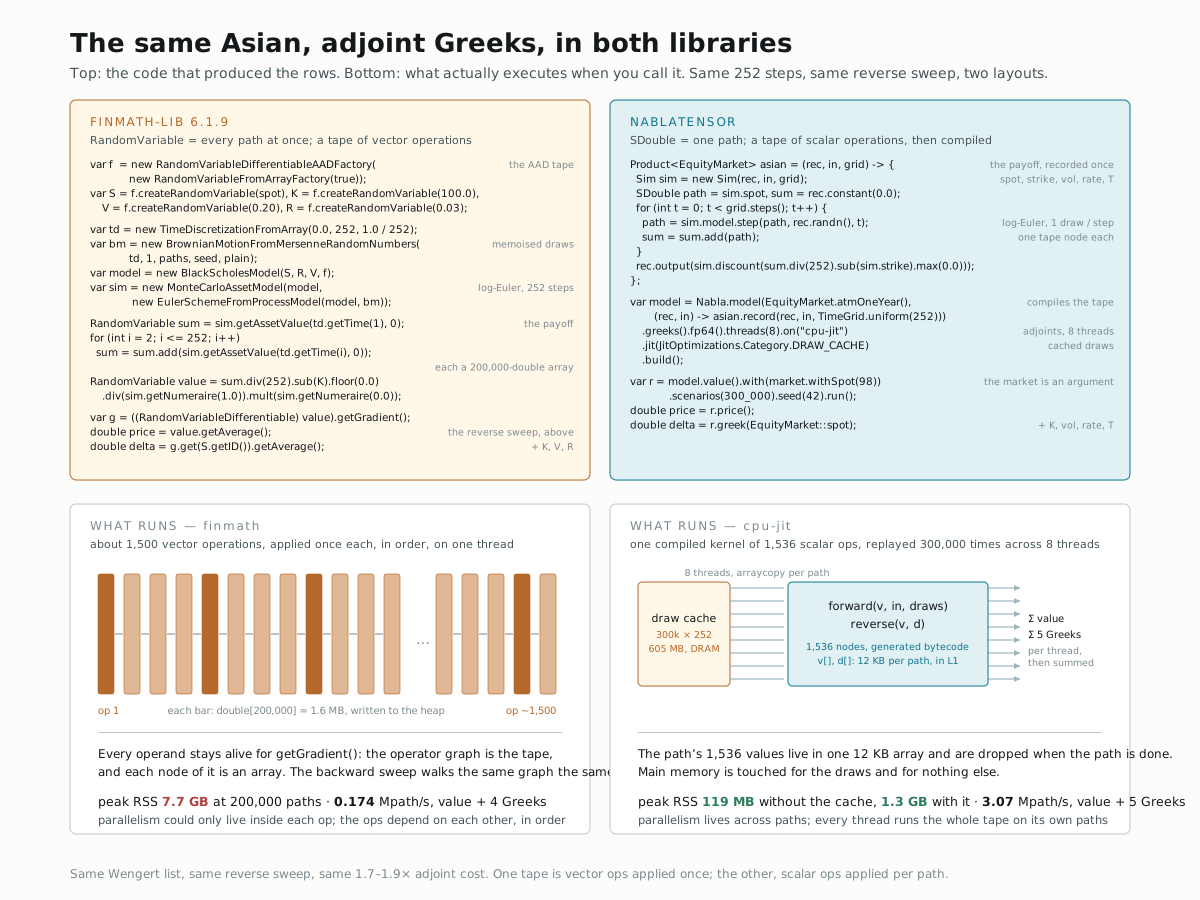
The code that produced the two Asian rows, and what each of them makes the machine do. Read the two bottom panels against the RSS column: the difference is not the maths, it is where the intermediate values live.
Where the three-per-core goes
The array-of-paths design has a cost that the one-step tape hid and the
252-step tape exposes: every intermediate is materialised. A RandomVariable
operation reads one or two arrays of 200,000 doubles from memory and writes a
new one. The Asian is 252 Euler steps of drift, diffusion, exp, multiply and
running sum, then the average and the payoff — on the order of 1,500 vector
operations, each a 1.6 MB write. The EulerSchemeFromProcessModel keeps every
step's state (it has to, the payoff reads all 252 fixings), and the AAD factory
keeps every operand of every operation, because the backward sweep will need
them. That is the 7.7 GB in the last column: not a leak, the operator graph
doing exactly what an operator graph over arrays has to do.
The compiled tape holds the same 1,536 values per path — 12 KB, in L1 — and
throws them away when the path is done. It touches main memory for the draws
and for nothing else. That is the difference between 119 MB and 7.7 GB, and it
is also, once the working set is bigger than any cache on the chip, the
difference between 0.51 and 0.174 million paths per second on a single core.
Same Wengert list, same reverse sweep, same Baur–Strassen bound on the adjoint
cost — finmath's Greeks pass is 1.9× its price pass with memoised draws,
cpu-jit's is 1.66× — but one of them is transposed, and the transposed one
streams its tape through DRAM.
The same tape, two layouts. NablaTensor's tape is a list of scalar operations, replayed once per path; the parallelism is across paths and lives in the thread count and the Vector API. finmath's tape is a list of vector operations, applied once, each over every path; the parallelism is inside each operation, and the tape itself runs sequentially. For a short tape with wide arrays the second layout wins on dispatch cost and ties per core. For a long tape it pays for every intermediate in memory bandwidth and heap, and cannot spread the operations across cores because they depend on each other in order. Neither is wrong. They are the two ways to vectorise a Monte Carlo, and the workload decides.
The draws, again
finmath's memoised BrownianMotion lifts its Asian price pass 2.7× and its
Greeks pass 2.0×. The draw-cache article measured 2.7× and 2.1× for
cpu-jit. Two libraries with different generators — Mersenne Twister with an
inverse CDF against Philox with Box-Muller — different array layouts and no
shared code arrive at the same lever with the same leverage, because on a
252-draw tape the random numbers are around two thirds of a price path
whichever way you compute the rest. If there is one number in this article
that generalises past the two libraries measured, it is that one.
Did they agree?
Different generators mean different noise, so nothing here is bit-comparable across libraries; what should agree is the estimate within its own standard error, and the Greeks within theirs.
| price | delta | dV/dK | vega | rho | dV/dT | |
|---|---|---|---|---|---|---|
| European, closed form (Strata, JQuantLib) | 9.4134 | 0.59871 | −0.50457 | 38.667 | 50.457 | 5.380 |
| European, finmath, 20 M paths, AAD | 9.4188 | 0.59883 | −0.50464 | 38.697 | 50.464 | — |
European, cpu-jit, 20 M paths, adjoint | 9.4122 | 0.59870 | −0.50458 | 38.661 | 50.458 | 5.380 |
| Asian, finmath, 200 k paths, AAD | 5.3140 | 0.56210 | −0.50896 | 22.465 | 23.603 | — |
Asian, cpu-jit, 300 k paths, adjoint | 5.3010 | 0.56163 | −0.50862 | 22.386 | 23.591 | 2.946 |
(dV/dT is the derivative with respect to maturity; Strata and QuantLib report
its negative and call it theta, −5.380.)
The European standard error at twenty million paths is 0.0032 as reported by
the engine; finmath sits 1.7 of them above the closed form and cpu-jit 0.4
below, which is what two independent estimates of the same number look like.
The Asian's standard error is 0.014 at 300,000 paths, and the two estimates
are 0.013 apart. The Greeks agree to three figures everywhere they overlap;
the one that does not overlap is dV/dT, because finmath's time grid is not
something its AAD can differentiate through, while for the tape maturity is
just another input node.
What to actually use
The ranking of the things that decided this comparison, in the order they decided it:
- Whether the library can run the product at all. Two of three could not run the Asian. No amount of per-core efficiency matters to a row that says "work in progress".
- Threads. 6× of the 17.6× on the Asian, all of the 6.3× on the European. finmath is a single-threaded library on a single-component model, as shipped; you can shard it yourself, and then the number you get is a measure of your sharding.
- Per-path versus per-array. A wash on a twenty-six-node tape; 2.9× per core and 7.7 GB against 119 MB on a 1,536-node one. This is the only line in the list that is about NablaTensor's design rather than its configuration, and it only shows up on the tape that needed simulation in the first place.
- The draw cache. 2–2.7× on the price pass in both libraries, and finmath's is on by default. If you take one engineering idea from this series to a codebase that is not NablaTensor, take that one.
- Adjoint Greeks. Not a differentiator between finmath and NablaTensor, because both have them and both pay about 1.7–1.9× a price pass for every Greek at once. A differentiator against everything that bumps.
If your book is closed-form products and curves, Strata is the production library and this article has nothing to tell you; 4.1 million valuations a second with the Greeks attached is the correct way to price a European. If your book is path-dependent and single-threaded is acceptable — or you are content to shard it yourself — finmath is a serious, honest, well-designed library that has had adjoint Greeks and cached draws for years, and it will tie the compiled tape per core on anything short. If your book is path-dependent, your tapes are long and you have cores, the tape kernel is 18× on this box before anyone touches a GPU.
Try it
The harnesses are plain main methods against Maven Central artefacts — no
build of any of the four libraries is required:
<dependency><groupId>net.finmath</groupId><artifactId>finmath-lib</artifactId><version>6.1.9</version></dependency>
<dependency><groupId>com.opengamma.strata</groupId><artifactId>strata-pricer</artifactId><version>2.12.74</version></dependency>
<dependency><groupId>co.dv01.jquantlib</groupId><artifactId>core</artifactId><version>0.3.0</version></dependency>
<dependency><groupId>com.nablatensor</groupId><artifactId>nablatensor-quant</artifactId><version>0.1.0</version></dependency>
<dependency><groupId>com.nablatensor</groupId><artifactId>nablatensor-simd</artifactId><version>0.1.0</version></dependency>
nablatensor-quant pulls in cpu-jit; simd is the second artefact and
needs --add-modules jdk.incubator.vector.
finmath's Asian with adjoint Greeks, in full — this is the code that produced its rows, minus the timing loop:
var f   = new RandomVariableDifferentiableAADFactory(new RandomVariableFromArrayFactory(true));
var rvS = f.createRandomVariable(spot);  var rvK = f.createRandomVariable(100.0);
var rvV = f.createRandomVariable(0.20);  var rvR = f.createRandomVariable(0.03);
var td  = new TimeDiscretizationFromArray(0.0, 252, 1.0 / 252);
var bm  = new BrownianMotionFromMersenneRandomNumbers(td, 1, paths, seed, new RandomVariableFromArrayFactory(true));
var model = new BlackScholesModel(rvS, rvR, rvV, f);
var sim   = new MonteCarloAssetModel(model, new EulerSchemeFromProcessModel(model, bm));

RandomVariable sum = sim.getAssetValue(td.getTime(1), 0);
for (int i = 2; i <= 252; i++) sum = sum.add(sim.getAssetValue(td.getTime(i), 0));
RandomVariable value = sum.div(252).sub(rvK).floor(0.0)
    .div(sim.getNumeraire(1.0)).mult(sim.getNumeraire(0.0));

Map<Long, RandomVariable> g = ((RandomVariableDifferentiable) value).getGradient();
double price = value.getAverage(), delta = g.get(rvS.getID()).getAverage();   // etc.
Reuse bm across the seven spots and you have finmath's draw cache; build a
new one per spot and you have the "fresh" row. Set -Xmx16g for 200,000 paths
and watch the resident set with /usr/bin/time -v, because the number in the
last column of the Asian table is the one that will decide whether your ladder
fits on your box before the throughput does.
Source:
bench/three-java-quant-libraries-one-ladder
(the three harnesses and their pom.xml, on the main engine repo),
JitReplay.java
(the NablaTensor side), and for finmath
RandomVariableDifferentiableAADFactory,
BrownianMotionFromMersenneRandomNumbers
and
EulerSchemeFromProcessModel
(the memoised increments and the per-component executor).